Today’s test session soundtrack: “Summer Breeze” by Seals & Crofts. Yes, it’s July in Florida. No, there is no actual summer breeze here — there is only summer soup. The closest thing to a breeze in this office is the cooling fan, and thanks to today’s results, even that barely had a job. More on that in a second.
The Session: 32-bit / 192kHz
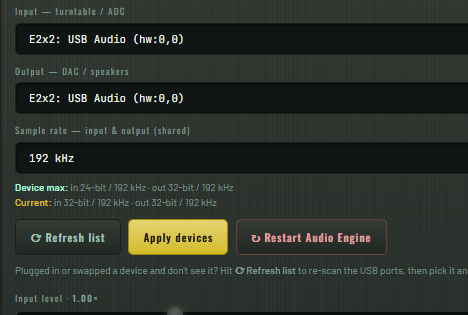
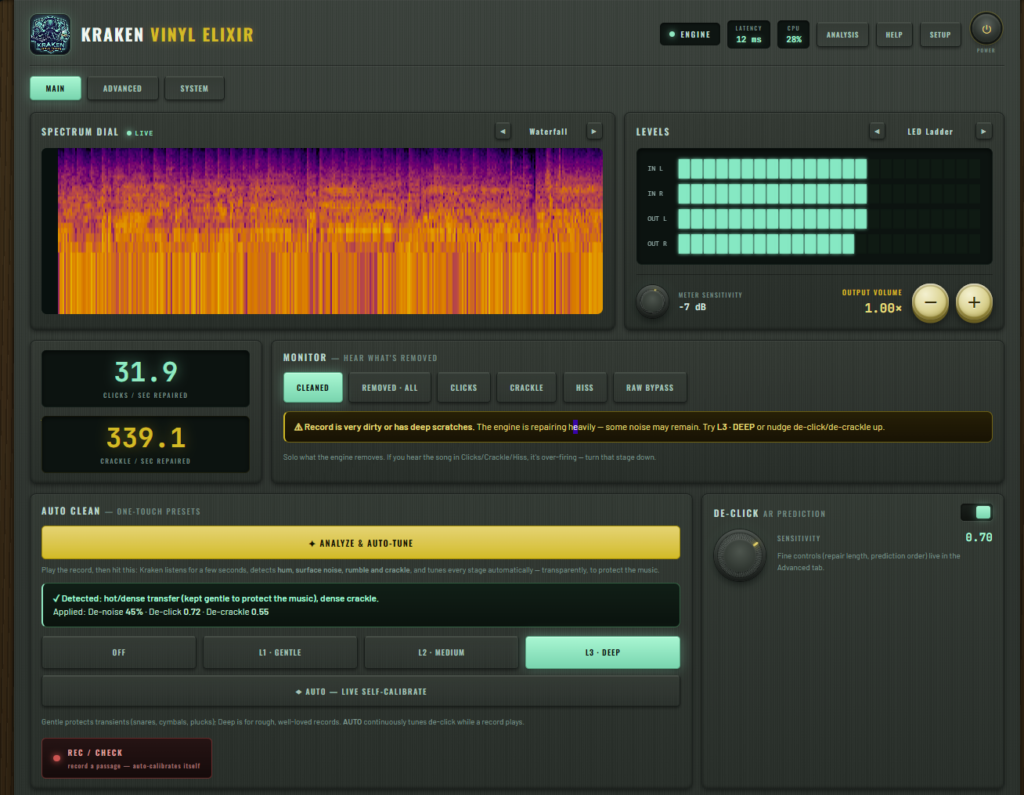
Today’s run was a high-resolution stress test: 32-bit, 192kHz playback through the engine — the most data-rich signal we’ve fed the Kraken yet. And the results have been genuinely impressive, for a reason that makes intuitive sense once you see it:
The higher the resolution, the better the engine repairs. Think of it like this: at higher sample rates, the engine gets more snapshots of every millisecond of music — which means when it finds a click, it has far more surrounding detail to study before reconstructing what belongs there. More data in, more precise surgery out. A repair that’s good at 44.1kHz becomes seamless at 192kHz, because the engine is working with a magnifying glass instead of reading glasses.
The Number That Made Us Smile: 28%
Here’s the stat of the day: running deep clean mode — our most aggressive processing — on a 32/192 stream, CPU usage sat at 28%. One quarter of the processor, doing maximum-effort restoration on more than four times the data of CD-quality audio, in real time, with room to spare.
That 72% of headroom isn’t just bragging rights. It’s what lets the same engine scale down to a Raspberry Pi and still hold real-time performance — and it’s what future features get to live in.
The Techy Bit: Resolution Profiles
Today’s session also feeds directly into a feature currently going into the engine: resolution profiles. We’re building dedicated profiles for the full range of real-world formats — 44.1, 48, 96, 176.4, and 192kHz, at 16, 24, and 32-bit — so the engine tunes its detection and repair behavior to the actual quality of the incoming signal.
Why it matters: a 16/44.1 stream and a 32/192 stream aren’t just different amounts of data — they deserve different handling. Detection thresholds, repair window sizes, and processing strategy all shift with resolution. With profiles, a modest USB dongle gets an engine tuned for what it delivers, and a high-res interface gets an engine that exploits every extra sample it provides. Same promise as always, now sharper: whatever your hardware gives us, the engine makes the most of it.
Meanwhile, “Summer Breeze” has never sounded smoother, the CPU is practically napping, and the only crackle left in this office is coming from the thunderstorm rolling in — which, unlike vinyl noise, we cannot patch. Yet.
So… go drop a needle. The Kraken’s got the rest.