A confession from the bench: the house chores are not getting done.
The new Elixir Engine V2 is deep in testing, and here’s the thing — every single record I drop is data. Each side played feeds the engine more audio to analyze, more damage varieties to catalog, more results to measure against. Every crackly garage-sale rescue makes the detection sharper; every pristine pressing proves the engine leaves clean music alone. So the daily question — flip another record, or do house chores? — isn’t really a contest. One of those activities fine-tunes a DSP engine. The other is laundry.
(The laundry has filed a formal complaint. The complaint has been noted and scheduled for “after beta.”)
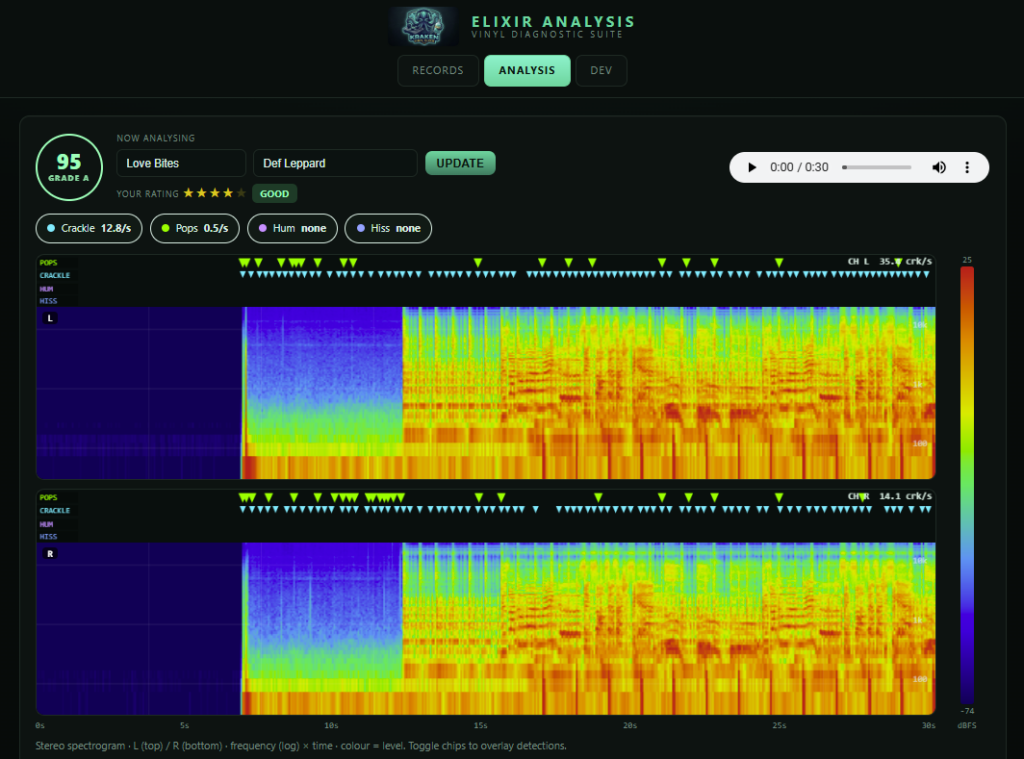
Today I want to show you what all that record-dropping actually produces, because the analysis readout from a real test record tells the whole story. Below is a genuine V2 diagnostic from a 30-second sample — with every number translated into plain English.
The Damage Report
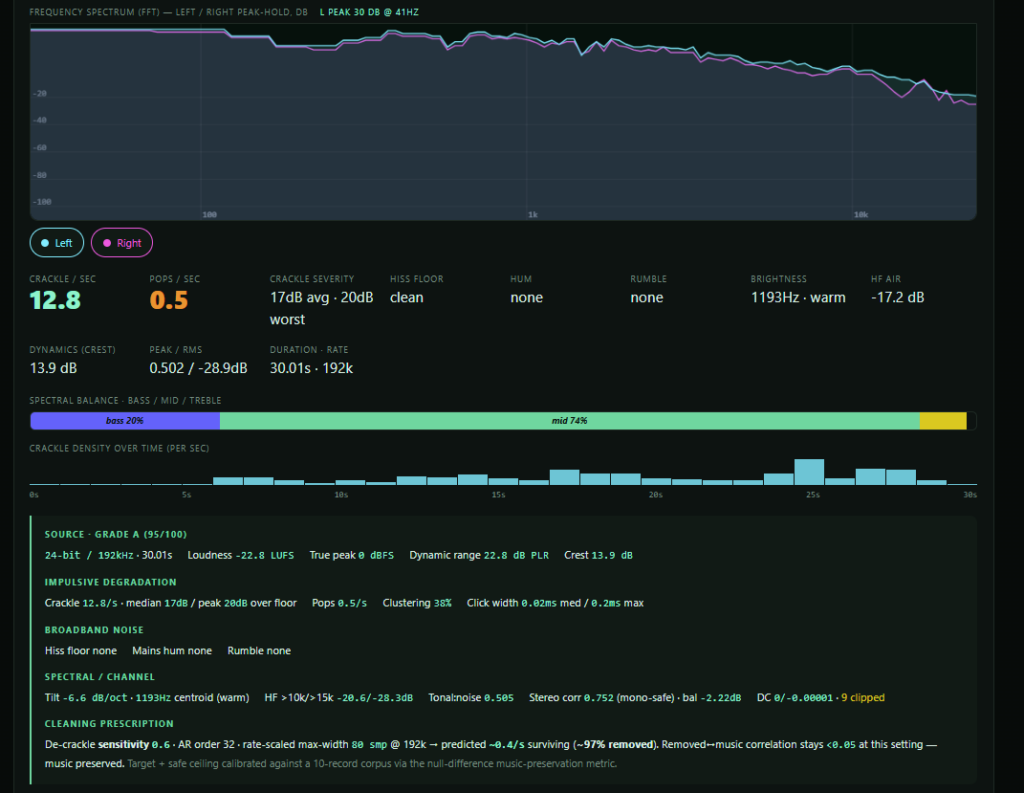
Crackle: 12.8 per second. Nearly thirteen crackle events every single second — that steady frying-pan fizz. Over a 20-minute side, that’s over 15,000 individual crackles. You stop hearing them as events and start hearing them as “vinyl sound.” They’re not. They’re 15,000 tiny problems.
Pops: 0.5 per second. A proper pop — the big, sharp click — every two seconds on average.
Crackle severity: 17dB average, 20dB worst. How loudly the crackle sticks up above the record’s noise floor. In plain terms: 17dB is roughly “clearly audible over quiet passages”; the worst offenders at 20dB punch through even louder. This isn’t subtle background texture — it’s damage with a megaphone.
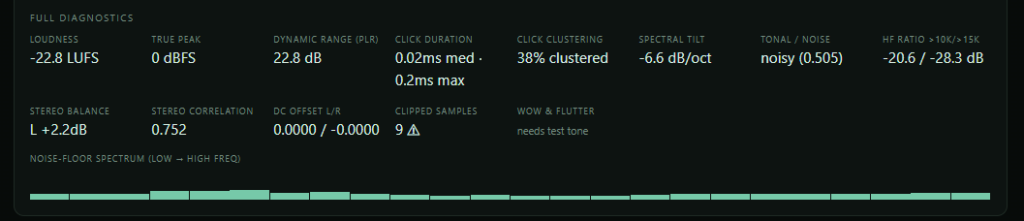
Click width: 0.02ms median, 0.2ms max. How brief each click is — the typical one lasts two hundredths of a millisecond. This is why repair is possible at all: the wounds are microscopic slivers of time, with healthy music on both sides to rebuild from.
Clustering: 38%. More than a third of the clicks arrive in bunches rather than randomly. Clusters usually mean physical causes — a scratch crossing several grooves, a patch of embedded grime — and the engine treats a burst differently than a lone tick.
The Health Report (The Good News)
Hiss floor: clean. Hum: none. Rumble: none. The three chronic diseases of vinyl playback — tape-style hiss, electrical hum, and low-frequency turntable rumble — are all absent. This record’s problems are entirely impulsive (clicks and crackle), not broadband (constant noise). That’s the best kind of patient: injuries, not illness.
Source grade: A (95/100). The engine grades the underlying recording itself, separate from the damage — and underneath all that crackle is an excellent capture: 24-bit/192kHz, huge dynamic range (22.8dB PLR — the music breathes between quiet and loud instead of being squashed flat), true peaks right at the ceiling without meaningful clipping (9 stray samples out of 5.7 million), and no DC offset (the waveform sits perfectly centered, as it should). Translation: this is a great record wearing a bad coat.
The Tone Report
Brightness: 1193Hz centroid — warm. The “center of gravity” of the record’s energy sits at 1193Hz, which lands in warm territory — more body than sizzle. Neither good nor bad; it’s the record’s personality, and the engine notes it so the cleaning preserves it.
HF air: -17.2dB, spectral tilt -6.6 dB/octave. How much sparkle lives up top, and how quickly energy rolls off toward the high frequencies. A gentle downward tilt like this is classic analog character — the engine’s job is to leave it exactly alone.
Stereo: correlation 0.752 (mono-safe), balance L +2.2dB. The two channels agree enough that the record won’t fall apart on a mono system, and the left channel runs about 2dB hot — worth knowing, possibly a cartridge/alignment note, and exactly the kind of thing the analysis surfaces for free.
The Prescription (This Is the V2 Magic)
Here’s where it gets good. Based on everything above, the engine wrote its own treatment plan:
De-crackle sensitivity 0.6, with a repair window scaled to the 192kHz rate. Not maximum aggression — calibrated aggression, matched to this record’s actual damage profile.
Predicted result: ~0.4 crackles per second surviving — roughly 97% removed. The engine forecasts its own outcome before committing.
And the safety number, the one we care about most: removed-audio-to-music correlation under 0.05. Plain English: the engine cross-checks that what it’s removing bears essentially no resemblance to the music — proof it’s extracting damage, not flesh. That threshold isn’t a guess; it’s calibrated against a ten-record test corpus using a music-preservation metric we’ve been refining for months. The engine doesn’t just clean — it proves, numerically, that it cleaned only the damage.
Did You Know? The Last Track Is the Hardest One
Here’s a fun one for your next record-night trivia: it’s genuinely harder to process audio from the last track on a side than the first one. Not because of wear, not because of damage — because of geometry.
A record spins at a constant speed (33⅓ RPM), but the groove circles get smaller as the needle travels inward. Same rotation, smaller circle — which means less vinyl passes under the stylus every second. At the outer edge, the stylus reads roughly twice as much groove per second as it does near the label. It’s like recording the same song on a long stretch of tape at the start of a side, and on half as much tape by the end.
The consequence: on inner tracks, the same music gets carved into physically smaller, tighter wiggles — especially the high frequencies, which get squeezed into details so fine the stylus struggles to trace them accurately. That’s why the last song on a side often sounds a touch harsher and grittier than the first, even on a mint record. Mastering engineers have known this forever — it’s why the big ballad often got sequenced first and rarely last.
For the engine, that means the raw signal itself gets rougher toward the label: more tracing distortion, less pristine detail to work with, and a trickier job telling true damage from inner-groove grit. It’s exactly the kind of thing V2’s analysis accounts for — and exactly why the test corpus includes full sides, first track to last, not just convenient outer-groove samples. If the engine only trained on track one, track five would embarrass it.
What This Means for You
Thirty seconds of listening → complete diagnosis → self-written prescription → predicted outcome → built-in proof of preservation. That’s the V2 pipeline — and every record dropped at this bench feeds it: more audio processed, more damage cataloged, more calibration data for the ten-record corpus that keeps growing past ten. It’s why the version tiers work the way they do: this automation is the heart of Pro, while Lite hands you these same insights with the knobs in your hands.
So no, the chores aren’t getting done. The records are. Somewhere between side flips, V2 gets a little smarter with every groove — and that trade will make sense to every vinyl person reading this.
So… go drop a needle. The Kraken’s got the rest.