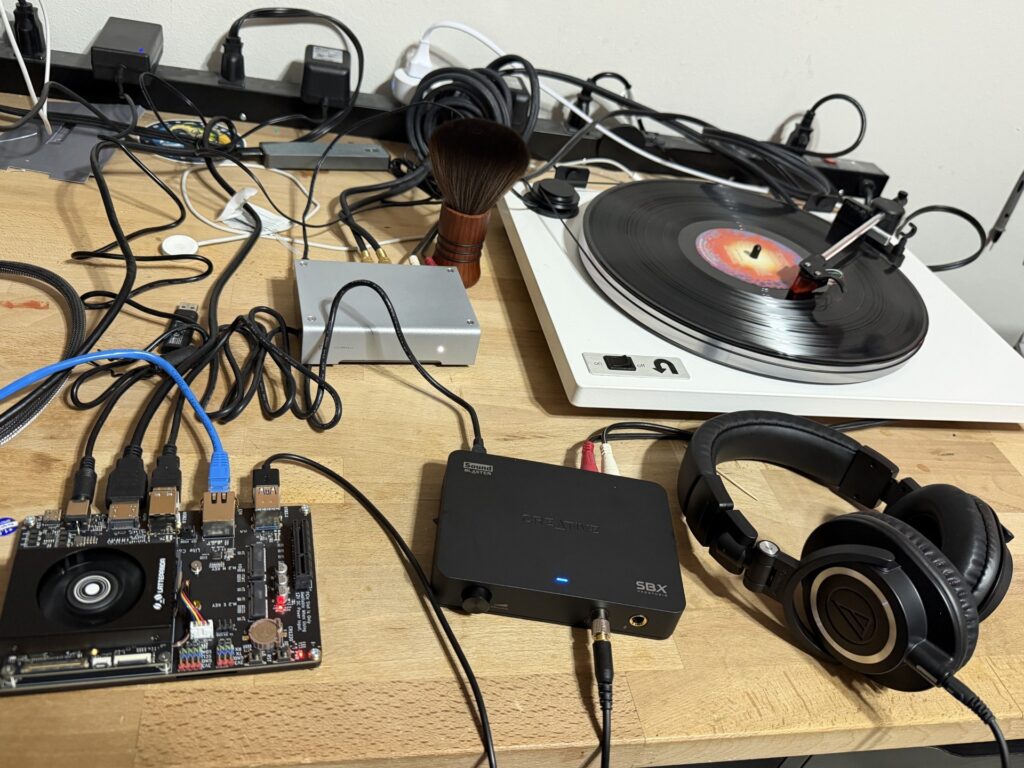
New arrival day at the bench, and this one set a record.
Ten minutes. That’s the time from the delivery driver’s thump on the porch to Kraken Vinyl Elixir running the new V2+ engine on the board — a LattePanda Mu (8GB, Intel N100), paired with a Sound Blaster HiFi HD ADC/DAC on capture and playback duty. Box open, board seated, fan installed, usb drive flashed, Debian installed, Kraken loaded, needle hovering. Ten minutes. Some IKEA furniture takes longer to get out of the packaging.
This is the payoff of the x86 strategy we’ve talked about all year: our finished build runs on x86 silicon with zero porting, so a new x86 board isn’t a project — it’s an unboxing. Here’s the first-impressions report.
The Little Board Packs a Punch
Don’t let the size fool you — the Mu module rides on its Lite Carrier board, and the whole assembled package is about the size of a smartphone. A complete x86 computer with a small foot print, and it moves. Debian installed easily, no drama, no hunting for weird images or vendor kernels — just standard x86 Linux behaving like standard x86 Linux, which after months of ARM board adventures feels almost suspiciously civilized. And the power-on-to-Kraken-loaded time is fast — cold boot to processing-ready quicker than the turntable takes to get up to speed. The N100 handles the V2+ engine with headroom to spare, and the 8GB of RAM means the analysis suite, the monitoring tools, and the engine all coexist without anyone elbowing anyone.
A BIOS. An Actual, Normal BIOS.
Small pleasure, big deal: the Mu has a simple BIOS to set up, just like a normal PC. If you’ve ever configured a desktop, you can configure this. No boot-order incantations, no vendor-specific flashing tools, no forum spelunking for the magic DTB file — you press the key, you see the familiar screens, you move on with your life. For a product whose promise is “runs on hardware normal people can manage,” a boring, familiar BIOS is genuinely a feature.
Built for a Box
Here’s the part with future written all over it: the Mu is a compute module — the brains on a small card, with the Lite Carrier providing the ports. Even fully assembled, the smartphone-sized footprint means putting it in a custom enclosure will be easy. Small package, modest power draw, cool-running — exactly the recipe for a tidy little unit that lives on a hi-fi shelf and looks like it belongs there. We’re not announcing anything. We’re just saying the bench has opinions about what this board wants to become when it grows up.
The Headline Number: USB Jitter, 40% Better
Now the finding that matters most to this project: USB jitter on the Mu measures roughly 40% better than the Raspberry Pi. Same interface, same records, same test protocol — the Mu’s USB subsystem simply delivers audio with meaningfully steadier timing. That’s less work for the variable buffer, more margin before compensation kicks in, and another data point confirming what the drift saga taught us: the board under the software matters as much as the interface beside it. The per-platform profiles in V2+ exist precisely because of differences like this — and now there’s a platform where the profile gets to relax a little.
What Happens Next: The Real Evaluation Begins
First impressions are nice. Data is better. The Mu now enters the part of the process that actually earns a verdict:
Overnight soak testing. The board gets fed prerecorded raw vinyl and processes it hour after hour through the night, every night, while the monitoring suite watches for the slow killers — memory creep, buffer drift, anything that only shows itself at hour six.
Long-duration streaming runs. Full album sides, back to back, real records with real damage — the closest thing to a customer’s actual Saturday, sustained for far longer than any Saturday runs.
Data logging, all of it. Every session gets recorded: CPU load, memory usage, buffer health, USB jitter measurements, and thermals under sustained deep-clean processing. When we publish numbers for this board, they won’t be impressions — they’ll be logs. That’s the standard every platform on the bench faces, and the Mu doesn’t get a pass for a charming first day.
Early Verdict: Very Impressed
That said — the first sessions have been hard to argue with. Fast, stable, painless to set up, smartphone-sized, and measurably better USB behavior than the boards we’ve been wrestling all summer. Ten minutes from doorstep to processing, and it hasn’t stumbled since.
The gauntlet will have the final word. But so far: very impressed.
So… go drop a needle. The Kraken’s got the rest.