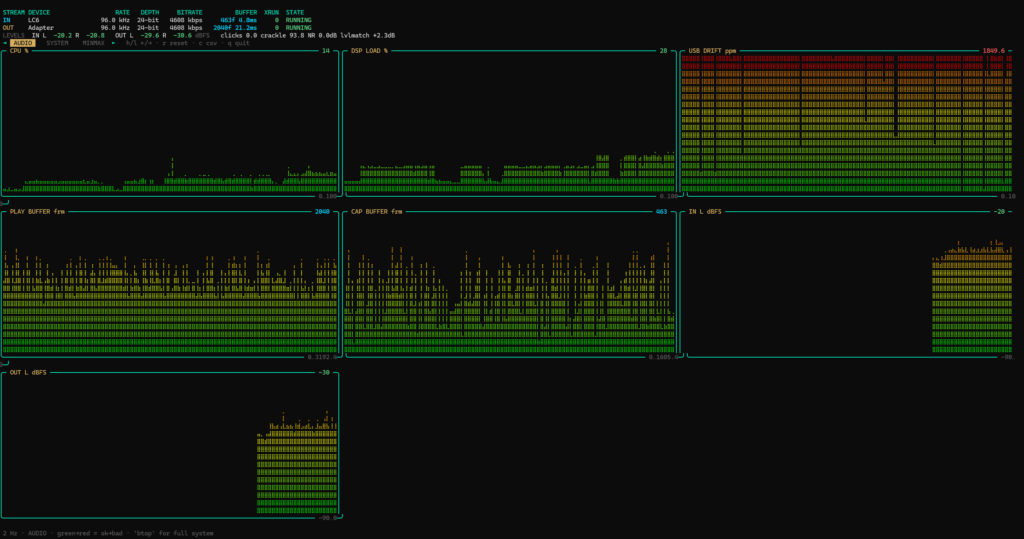
When people ask why we spend so much time testing audio hardware at the KVE bench, the answer comes down to something most spec sheets never mention: every audio device is secretly a clock, and no two clocks agree.
That sounds like an audiophile riddle, so let’s unpack it in plain English.
Digital Audio Is Just Very Fast Photography
When your USB interface captures the signal coming off your turntable, it isn’t recording a continuous wave. It’s taking snapshots — measuring the voltage of the signal tens of thousands of times per second. At CD quality, that’s 44,100 snapshots per second. At the 96 kHz we prefer for vinyl work, it’s 96,000.
For this to work, two things have to be true:
- The snapshots have to happen at the advertised rate, and
- They have to be evenly spaced.
Both of those jobs belong to a tiny quartz crystal inside the device — its clock. And here’s the part nobody tells you: that clock is never exactly right.
Every Clock Lies a Little
Think of two wristwatches. You set them both to noon, walk away, and come back a month later. One says 12:00:03, the other says 11:59:56. Neither watch is broken — they’re just physical objects, and physical objects are never perfect. One runs a hair fast, the other a hair slow.
Audio clocks are the same. A device labeled “96,000 Hz” might actually run at 96,000.8 Hz. Another might run at 95,999.4 Hz. The spec sheet rounds; the crystal doesn’t. Temperature, manufacturing tolerance, even the age of the component all nudge the true speed. In electronics this is measured in parts per million (ppm), and a difference of a few ppm between two devices is completely normal.
For most uses, a few ppm is nothing. For real-time audio flowing between two devices, it’s everything.
Drift: When Two Clocks Slowly Disagree
Here’s where it bites. A system like Kraken Vinyl Elixir sits between two clocked devices: an ADC capturing your turntable, and a DAC playing the cleaned signal to your amp. The ADC produces samples at its idea of 96,000 per second. The DAC consumes them at its idea of 96,000 per second.
Now picture a bucket with a hose filling it and a drain emptying it. If the hose delivers even slightly more water than the drain removes, the bucket eventually overflows. If the drain runs slightly faster than the hose, the bucket eventually runs dry. It doesn’t matter how tiny the mismatch is — given enough time, one of those two things will happen.
That bucket is the audio buffer. When it overflows, samples get dropped — you hear a click or a stutter. When it runs dry, the DAC has nothing to play — you hear a gap or a glitch. This slow, inevitable disagreement between two “identical” clocks is called clock drift, and it’s the reason a setup can sound flawless for ten minutes and then hiccup out of nowhere at minute eleven.
Jitter: When One Clock Stutters
Drift is a clock running at the wrong average speed. Jitter is a clock being inconsistent moment to moment — imagine a drummer who finishes the song at the right tempo overall, but rushes some beats and drags others along the way.
When snapshots aren’t evenly spaced, the reconstructed waveform gets subtly smeared. You won’t hear clicks from jitter — you’ll hear something sneakier: a slightly hazy top end, less precise stereo imaging, a noise floor that’s higher than it should be. On a vinyl restoration system, where the whole point is pulling detail out of the noise, jitter quietly works against everything the software is trying to do.
Why This Is a USB Story
USB audio devices handle the clock problem in different ways. Some run in a mode where the computer effectively paces the audio stream; others (usually the better ones) run asynchronously, where the device’s own clock is the boss and it tells the computer when to send or fetch data. Different chipsets, different firmware, different behavior — and on a machine like the Raspberry Pi 5, with its own USB controller quirks, those differences get amplified. Two interfaces with identical numbers on the box can behave completely differently once real-time audio is flowing through them for an hour straight.
Which Is Why We Test
This is the honest reason hardware testing sits at the center of how we build KVE. The software can’t assume the clocks agree, because they never do. The engine has to measure the real rate at which samples arrive, manage its buffers around the actual drift between your ADC and DAC, and keep the stream seamless while the two clocks quietly argue with each other.
And software can only do that well on hardware it understands. So every interface we recommend goes on the bench — oscilloscope, meter, long-duration streaming runs, full album sides at a time — before it earns a spot on the list. Not because the untested gear is bad, but because “96 kHz” on a box tells you almost nothing about how a device actually keeps time.
Your records deserve hardware that can hold a beat. We make sure of it, so you don’t have to.
So… go drop a needle. The Kraken’s got the rest.