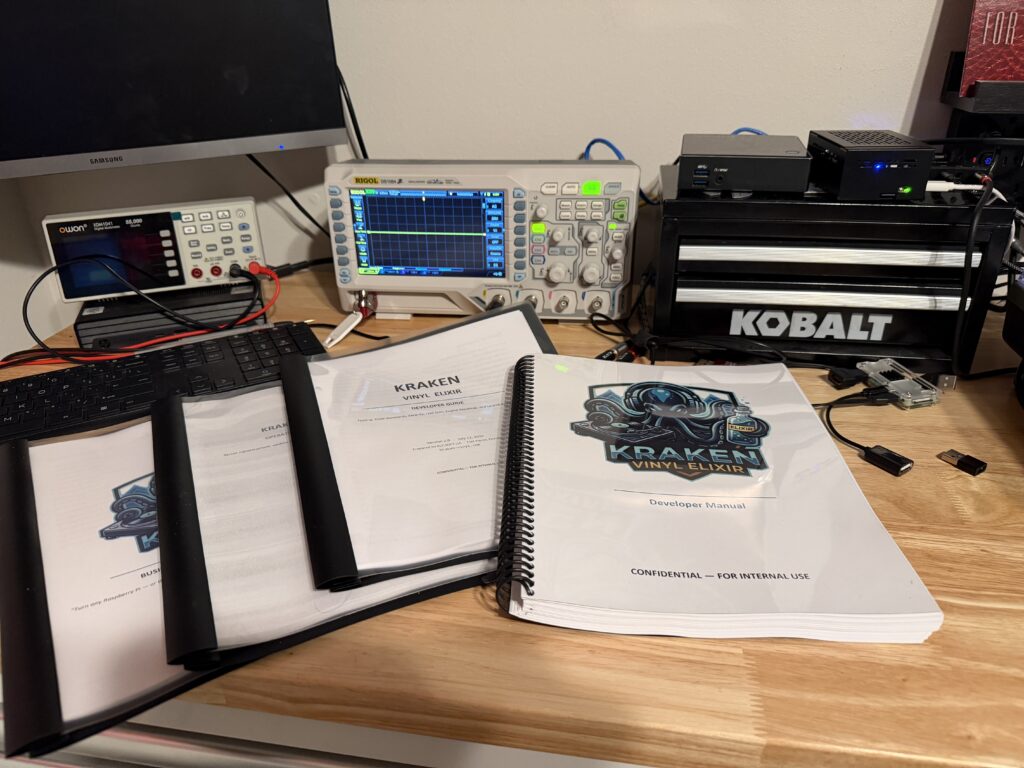
Ask most people what matters most when building software and you’ll hear the usual answers: talent, testing, tools, caffeine. All true. But after months of building Kraken Vinyl Elixir, I’ll give you the real answer, and it’s not glamorous:
Documentation.
Not the read-me-later kind. The kind you write while you build, that captures every decision, every algorithm, every “why did we do it this way?” before the answer evaporates. Here’s what that looks like on this project.
256 Pages of Technical Foundation
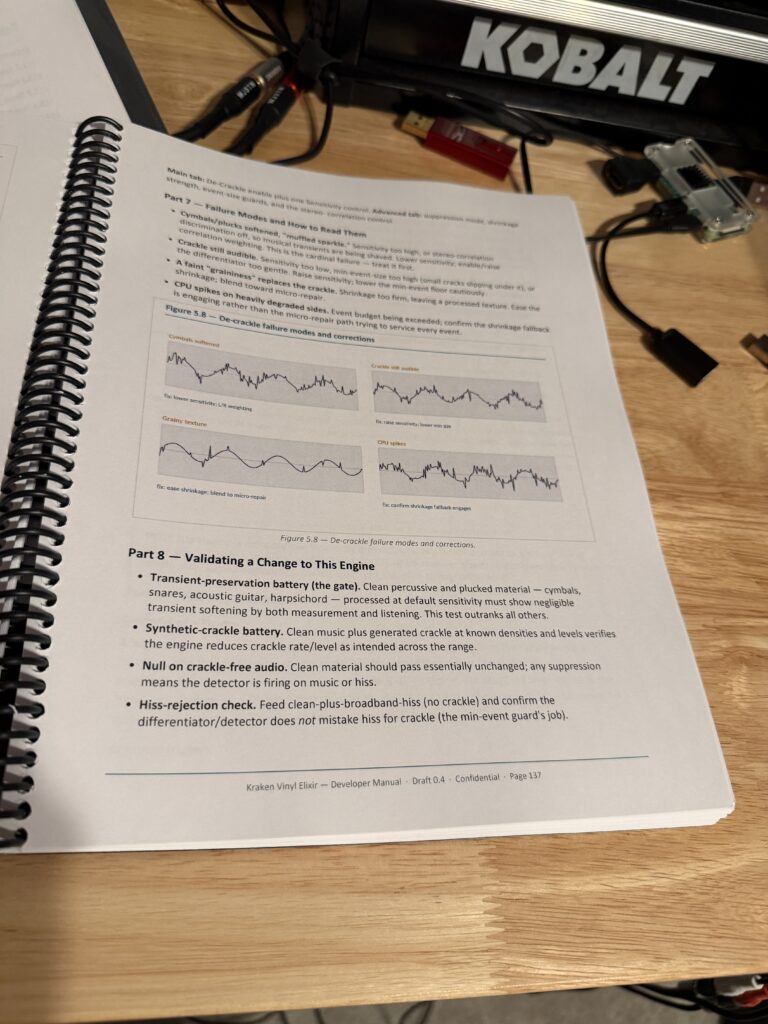
Sitting behind KVE is a technical library that currently runs 256 pages, covering everything from raw signal processing theory to the subtle art of editing sound waves so the result actually sounds good — not just measures well.
That distinction is the heart of it. The math of finding and repairing a click is one discipline. Making the repair musical is another one entirely, because the final judge isn’t an equation — it’s the human ear. Our ears are ruthless about some flaws and forgiving about others. A repair can be mathematically “correct” and still sound wrong: a hair too smooth, a transient slightly blunted, a moment where the music seems to hold its breath. So the documentation doesn’t stop at how the algorithms work; it records how the result should sound, what the ear will and won’t tolerate, which repairs fooled everyone in a blind listen and which ones got caught — and why.
Every one of those lessons cost hours at the bench to learn. Written down, they’re permanent. In someone’s head, they’re one busy week away from being lost.
80 Pages of Architecture
Alongside the technical library sits 80 pages of software architectural design: how the real-time engine, the processing chain, the interface, and the system underneath all fit together, plus the feature set — current, in progress, and planned — so nothing lives only as a sticky note or a stray thought at 2 a.m.
This is how a project with this many moving parts stays coherent. When every feature is documented before and as it’s built, nothing collides, nothing gets half-implemented twice in two different ways, and every new idea gets weighed against the whole design instead of bolted on wherever it fits. The architecture docs are the map; the code is just the territory catching up to it.
Why Bother? Because Launch Day Is a Promise
Here’s the honest reason we hold ourselves to this standard: we are committed to having a solid product at launch.
Plenty of software ships as a pile of undocumented decisions held together by the founder’s memory. It works — right up until the first hard bug report, the first odd hardware combination, the first feature request that touches something nobody quite remembers building. Then the wheels come off, and the users pay for it.
We’re taking the opposite bet. Over three hundred pages of documentation means that when an alpha tester reports something strange, we’re not guessing — we can trace exactly what the engine does and why. It means new features get built on a foundation we understand completely. It means the product you buy behaves the way the manual says it does, because the manual and the software grew up together.
Records reward people who take care of things. Turns out software is the same way.
So… go drop a needle. The Kraken’s got the rest.