Few questions start a fight in vinyl circles faster than this one. Whether a $100 cable “sounds better” than a $15 one is a debate for another time (and probably another beverage). But during KVE testing, we learned some things about cables that aren’t a matter of opinion — we watched them happen on the bench. Here’s what we found, what it means for your setup, and the feature it inspired us to build.
Your Phono Cable Is an Antenna. Sorry.
The signal coming off a phono cartridge is tiny — a few thousandths of a volt. For comparison, a line-level signal from a CD player or streamer is hundreds of times stronger. That means anything that leaks into a phono cable gets amplified hundreds of times more than the same leak on any other cable in your system. And thanks to the RIAA equalization curve applied to every phono signal, the low frequencies get boosted even further — which is exactly where power-related hum lives. The deck is stacked against you before the music even starts.
And RCA cables are, electrically speaking, decent antennas. The standard RCA connection is unbalanced — one signal conductor and a ground — which means it has no built-in mechanism for rejecting interference the way balanced pro-audio cables do. Whatever electromagnetic noise the cable picks up along its run rides straight into your preamp along with the music.
What We Saw on the Bench
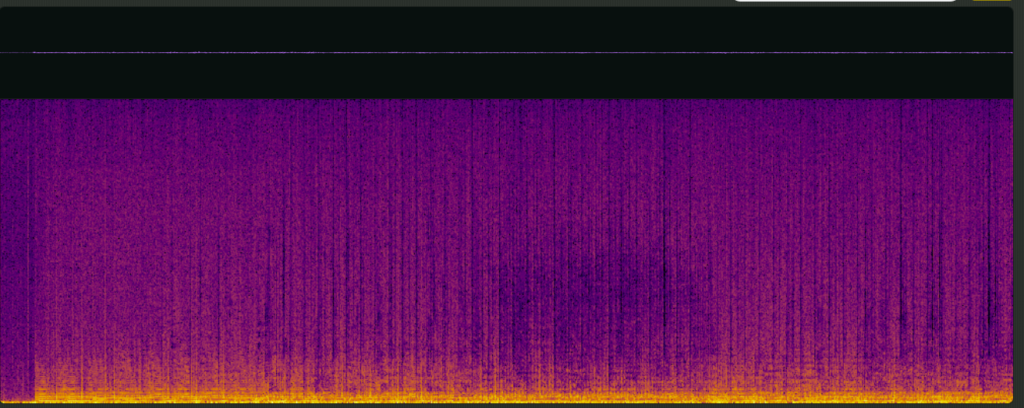
During testing, we found measurable interference being induced into the signal whenever RCA cables ran next to power supplies and miscellaneous electrical devices. This isn’t subtle-audiophile-adjective territory — it shows up plainly on the spectrum analyzer.
Two main culprits kept appearing:
Power-line hum. Route a phono cable alongside a power cord or transformer and the alternating magnetic field induces a voltage right into the signal conductor — classic hum at the power-line frequency and its harmonics, the same family of noise our bench meter fingerprints through the RCA inputs.
Switch-mode power supply hash. This is the modern menace. Nearly every wall wart, phone charger, LED driver, and small gadget today uses a switching power supply that chops current tens of thousands of times per second. Each one sprays a faint haze of high-frequency noise, and a phono cable draped near a power strip full of them will happily collect it. Individually invisible; together, a measurably raised noise floor.
The fix costs less than a record. Distance is free — keep signal cables away from power cables, and where they must meet, cross at right angles instead of running parallel. Beyond that, a properly shielded cable — a real braided or foil shield around the signal conductor, correctly grounded — knocks down most induced interference. That’s a build-quality feature, not a luxury feature. Plenty of well-made shielded cables cost $15–30. So: good shielded cable, yes. $100 cable, only if it makes you happy.
The Discovery That Became a Feature
Here’s where testing turned into product development. While running long bench sessions, we kept noticing stray frequencies creeping into the spectrum analyzer — narrow, steady spikes that had nothing to do with the record. They didn’t behave like clicks or surface noise. They were environmental: interference riding in through the RCA cables from the electrical ecosystem around the turntable.
And here’s the uncomfortable truth we had to face: every listening room has its own version of this. Your house’s wiring, your gear, your wall warts, your dimmer switches — the specific noise fingerprint entering your system is unique to your setup. We could ship a system tested spotless on our bench, and it would still be sitting in the middle of your electrical environment, not ours.
So we built self-calibration mode.
During initial setup, KVE listens to your system with no music playing and learns what your environment sounds like — measuring the specific interference frequencies present on your RCA connection: your hum, your harmonics, your switching-supply hash. That measured profile becomes a fingerprint of your room’s electrical noise. From then on, the engine filters those specific, steady interference components out of the signal — surgically, at the exact frequencies it measured, rather than carving broad holes in the audio and hoping the noise falls inside them.
The distinction matters. Steady environmental interference sits at fixed frequencies; music moves constantly. Because the calibration knows precisely where your noise lives, it can remove a spike a fraction of a hair wide and leave the bass line an eyelash away completely untouched.
The Takeaway
Cable care, in order of value per dollar:
- Routing costs nothing. Keep phono cables away from power supplies and power cords. Where they must cross, cross at 90 degrees.
- Shielding is cheap. A well-made shielded RCA cable handles the rest of the physical battle without a three-figure price tag.
- The Kraken handles what’s left. Whatever your room’s electrical fingerprint sneaks past steps one and two, self-calibration learns it and filters it — automatically, during setup.
Spend the leftover $70 on records. That’s our official position.
So… go drop a needle. The Kraken’s got the rest.