Beta Update: Q4 2026 — And Why That’s the Right Call

Let’s get the headline out of the way, plainly and without spin:

The Kraken Vinyl Elixir invitational beta is officially moving from late Q3 to TBD Q4 2026.

Here’s the thinking, and it’s the same thinking that’s guided this project from the first line of documentation: we want a quality beta test. If getting there means hitting the delete key on a module inside Elixir and recreating it from scratch — then that’s exactly what needs to happen, and it has happened. Rushing to hit a calendar quarter is not the mindset we run this project on. A quality product needs time, and we’d rather move a date than ship a compromise.

So that’s the news. Now here’s what the time is buying you.

1. Engine V2 Is in Tuning

The new engine — variable buffering, per-platform compensation, resolution profiles, the self-writing cleaning prescriptions we showed off recently — is built and deep in tuning. This is the slow, obsessive, one-millimeter-at-a-time phase where the engine goes from working to right. It doesn’t rush well, and we’re not rushing it.

2. The Hardware Keeps Flowing (And Keeps Teaching)

The compatibility program started simply enough: get the engine talking to USB audio devices. Then we got the jitters — literally. USB jitter, clock drift, buffer chaos on budget converters, worse on some platforms than others. So: testing, testing, testing. Boards and converters are still arriving from around the world, each one getting profiled, and each profile making the engine harder to surprise. Every device that crosses the bench before beta is a problem you never meet after it.

3. We Went Back to the Drawing Board on Our Own Tools

Somewhere in all that testing we asked a bigger question: forget the engine for a second — how do we make the tools that test the engine better? The answer became a full re-engineering of the Elixir Analysis vinyl diagnostic suite:

More data, faster simulations, better analysis — including something we’re genuinely excited about: the suite can now distinguish vocals, instruments, and the noise that needs processing as separate things. The analyzer doesn’t just see “audio with damage” anymore; it understands what kind of material it’s protecting while it hunts what it’s removing.

And it runs simulations before the engine ever touches your record. Here’s why that matters. A scratch can be tiny or huge — a hairline tick lasting a fraction of a millisecond, or a gouge plowing across multiple grooves. Those are completely different repair jobs, and treating them the same is how restoration goes wrong: repair too little and the damage survives; repair too aggressively and you replace the scratch with something worse — an artificial artifact, a smear of processing where music used to be. The reengineered suite solves this by rehearsing the repair before performing it: it simulates the fix at the damage’s actual measured size, checks the simulated result against the surrounding music, and only commits when the repair is proven to fit the wound — as small as possible, as large as necessary, and never a sample more. The scratch gets exactly the surgery it needs. The music never gets operated on by mistake.

4. More Turntables, More Styli

The listening side of the bench is growing too: we’re acquiring additional record players and styli, because the engine has to sound right regardless of what’s doing the tracing — different decks, different tips, different signal characters. More sources in, fewer assumptions baked in.

5. Building the Knowledge Base

And finally, a project for you: we’re building a knowledge base to help users feed Elixir the best possible signal — because the cleanest processing in the world can’t beat a well-set-up turntable handing it good audio in the first place.

Be honest: how many people actually know what tracking force, cartridge alignment, or anti-skate are? No shame — nobody’s born knowing. But they matter enormously. If the needle presses too heavily, it grinds the groove walls down — permanently wearing your records with every play while the sound goes dull and lifeless. Too light, and the stylus can’t hold the groove — it chatters and mistracks, spraying harsh distortion and bouncing against the vinyl in a way that damages records even faster than tracking heavy. There’s a happy zone, it’s printed in your cartridge’s manual, and a $15 gauge gets you there in five minutes. That’s the kind of thing the knowledge base will teach — plainly, without gatekeeping — so that when Elixir arrives, it’s cleaning the best signal your table can produce.

The Bottom Line

Q3 ends; the standard doesn’t. The engine is becoming what it should be, the tools got rebuilt better than they were, the hardware library keeps deepening, and the date moved to make room for all of it. TBD Q4 2026. When we announce the beta date, it’ll be because the software earned it — not because the calendar demanded it.

Thank you for the patience. It’s being spent carefully.

So… go drop a needle. The Kraken’s got the rest.
The audio-junkie confession post — this one gets to be the most personal of the tuning series. Here it is:

Hello. My name is Richard, and I’m an audio junkie.

(“Hi, Richard.”)

It’s been zero days since my last critical listening session. I own more headphones than a person has ears. I have opinions about pressing plants. When a song comes on, I don’t hear the chorus — I hear the cymbal decay at 2:47 and whether the denoiser breathed on it. My family has learned that “one more song” is a unit of time with no fixed value.

I tell you this because tuning the Kraken’s sound isn’t a spec-sheet exercise. It’s an obsession with a workflow. Here’s what that actually looks like.

The Loop: Tweak, Analyze, Stare, Repeat

The daily ritual runs on our custom analysis software, and it’s beautifully monotonous: make a slight change to the engine — one parameter, one nudge — then run a full analysis and do a cross-visual comparison: the before and after, side by side on screen, waveforms and spectra overlaid, hunting for exactly what changed and only what changed. Then listen. Then tweak again.

One session might be thirty of these loops. It’s the audio equivalent of adjusting a picture frame one millimeter at a time for four hours. It is also, and I cannot stress this enough, the best part of my day.

The Secret Weapon: We Know These Records By Heart

Here’s an advantage no instrument can replicate: we grew up on the music we’re testing. These aren’t lab signals — they’re the records that lived in our houses. When you’ve heard a song a thousand times across four decades, you don’t need a chart to know something’s off. The engine touches a note wrong and it registers like a typo in your own name.

And we stack the deck further: we test with different masterings of the same album and different condition grades of the same pressing — the mint copy, the good copy, the garage-sale tragedy. Same music, different sources, so we learn what’s the recording, what’s the pressing, and what’s the damage. The engine has to get all three right, and we can tell the difference because our ears did the homework decades before the software existed.

The hardware side does its homework too — the learning profiles we’ve written about mean the engine knows each ADC and DAC’s personality before the music even starts. Calibrated gear, calibrated ears.

The Listening Rig: Three Headphones and an Apology to the Neighbors

Every candidate tuning faces the jury: three different brands of headphones — because every headphone lies a little differently, and a tuning that survives three different liars is probably telling the truth — and then the speakers, cranked to “the household has been notified” volume, because headphones and rooms disagree, and the Kraken has to sound right in both.

This feeds what we call the vinyl expectation process: the engine’s output is voiced against what a record should sound like — not a lab ideal, a record — and then the built-in EQ hands the final say to you. Our expectation sets the foundation; your taste finishes the mix. We tune the engine to be right; the EQ exists because “right” and “the way you like it” are allowed to be two different things.

The Question Everyone Asks: Do We Want Records to Sound Like CDs?

NOPE.

Full sentence: nope. If we wanted digital sterility, there’s a streaming app for that. The warmth, the ever-so-gentle analog roll-off, the way a needle in a groove feels — that’s not a defect to engineer away, that’s the entire point of the format. The Kraken removes what’s broken, never what’s vinyl.

The Expectations, In Writing

So here’s the contract, straight from the tuning bench:

1. Remove the artifacts that hurt the sound. Clicks, pops, crackle, hum, noise — the damage goes.

2. Know when to stop. This one matters: on a record in truly rough condition, the engine processes up to a calibrated point — and no further. Past that point, more processing stops helping and starts hurting: push harder and the sound deteriorates, and you trade the record’s artifacts for processing artifacts, which is a terrible trade. Restraint is a feature. The engine is tuned to walk away from the table while it’s still winning.

3. Make records sound like RECORDS. Cleaner, quieter, healthier — and unmistakably, warmly, gloriously vinyl.

That’s the whole philosophy, tuned one millimeter at a time, verified by three lying headphones, some very loud speakers, and a lifetime of knowing exactly how these songs are supposed to sound.

Now if you’ll excuse me — it’s been several minutes since my last critical listening session, and the bench is calling.

So… go drop a needle. The Kraken’s got the rest.
Engine V2 Testing: Flip Records or Do House Chores?

A confession from the bench: the house chores are not getting done.

The new Elixir Engine V2 is deep in testing, and here’s the thing — every single record I drop is data. Each side played feeds the engine more audio to analyze, more damage varieties to catalog, more results to measure against. Every crackly garage-sale rescue makes the detection sharper; every pristine pressing proves the engine leaves clean music alone. So the daily question — flip another record, or do house chores? — isn’t really a contest. One of those activities fine-tunes a DSP engine. The other is laundry.

(The laundry has filed a formal complaint. The complaint has been noted and scheduled for “after beta.”)

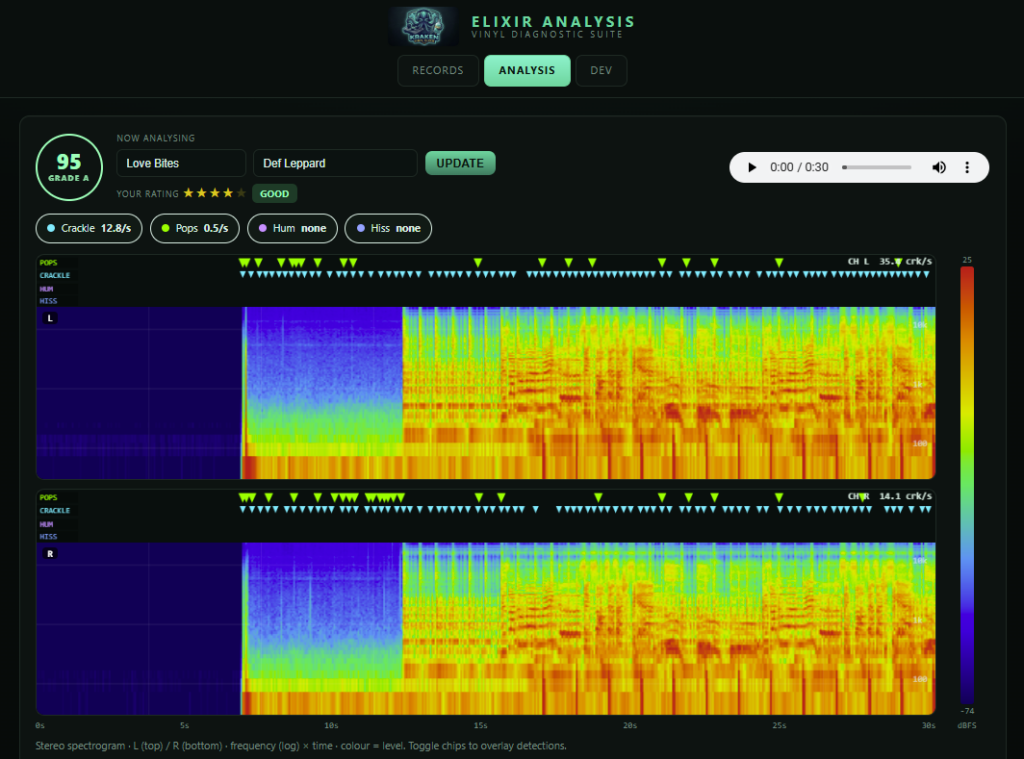
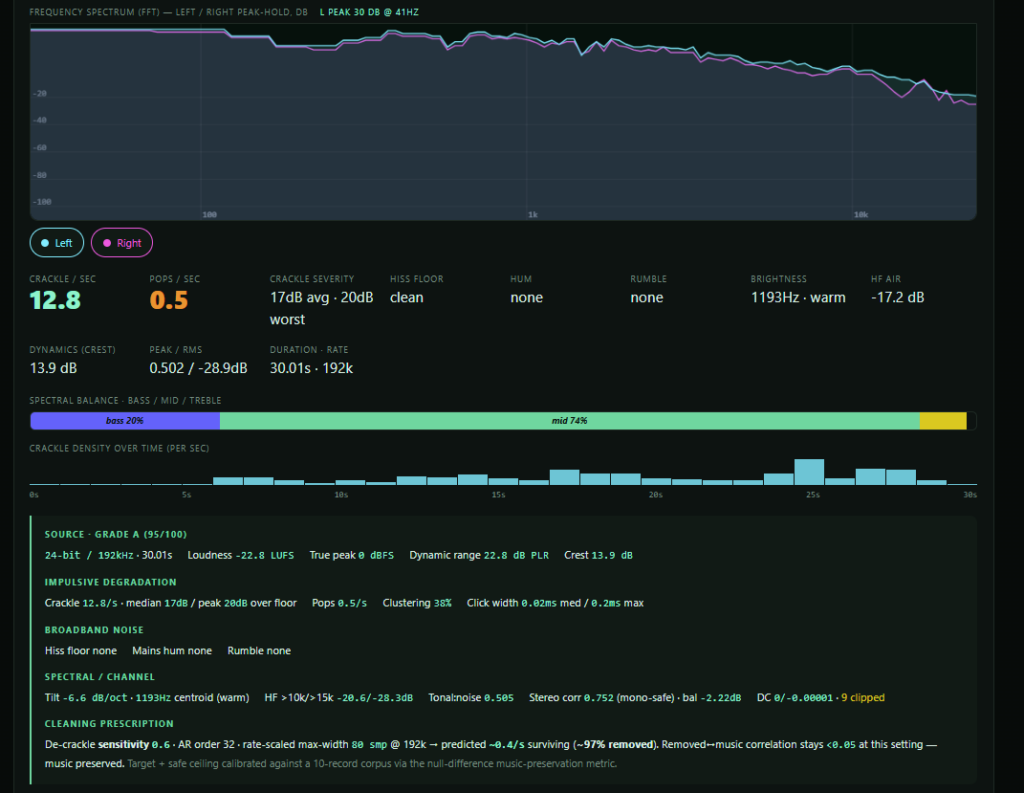
Today I want to show you what all that record-dropping actually produces, because the analysis readout from a real test record tells the whole story. Below is a genuine V2 diagnostic from a 30-second sample — with every number translated into plain English.

The Damage Report

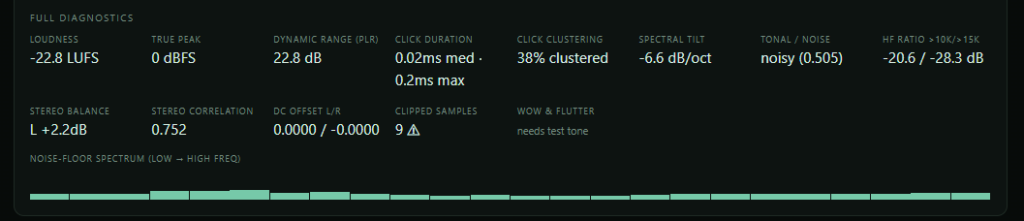
Crackle: 12.8 per second. Nearly thirteen crackle events every single second — that steady frying-pan fizz. Over a 20-minute side, that’s over 15,000 individual crackles. You stop hearing them as events and start hearing them as “vinyl sound.” They’re not. They’re 15,000 tiny problems.

Pops: 0.5 per second. A proper pop — the big, sharp click — every two seconds on average.

Crackle severity: 17dB average, 20dB worst. How loudly the crackle sticks up above the record’s noise floor. In plain terms: 17dB is roughly “clearly audible over quiet passages”; the worst offenders at 20dB punch through even louder. This isn’t subtle background texture — it’s damage with a megaphone.

Click width: 0.02ms median, 0.2ms max. How brief each click is — the typical one lasts two hundredths of a millisecond. This is why repair is possible at all: the wounds are microscopic slivers of time, with healthy music on both sides to rebuild from.

Clustering: 38%. More than a third of the clicks arrive in bunches rather than randomly. Clusters usually mean physical causes — a scratch crossing several grooves, a patch of embedded grime — and the engine treats a burst differently than a lone tick.

The Health Report (The Good News)

Hiss floor: clean. Hum: none. Rumble: none. The three chronic diseases of vinyl playback — tape-style hiss, electrical hum, and low-frequency turntable rumble — are all absent. This record’s problems are entirely impulsive (clicks and crackle), not broadband (constant noise). That’s the best kind of patient: injuries, not illness.

Source grade: A (95/100). The engine grades the underlying recording itself, separate from the damage — and underneath all that crackle is an excellent capture: 24-bit/192kHz, huge dynamic range (22.8dB PLR — the music breathes between quiet and loud instead of being squashed flat), true peaks right at the ceiling without meaningful clipping (9 stray samples out of 5.7 million), and no DC offset (the waveform sits perfectly centered, as it should). Translation: this is a great record wearing a bad coat.

The Tone Report

Brightness: 1193Hz centroid — warm. The “center of gravity” of the record’s energy sits at 1193Hz, which lands in warm territory — more body than sizzle. Neither good nor bad; it’s the record’s personality, and the engine notes it so the cleaning preserves it.

HF air: -17.2dB, spectral tilt -6.6 dB/octave. How much sparkle lives up top, and how quickly energy rolls off toward the high frequencies. A gentle downward tilt like this is classic analog character — the engine’s job is to leave it exactly alone.

Stereo: correlation 0.752 (mono-safe), balance L +2.2dB. The two channels agree enough that the record won’t fall apart on a mono system, and the left channel runs about 2dB hot — worth knowing, possibly a cartridge/alignment note, and exactly the kind of thing the analysis surfaces for free.

The Prescription (This Is the V2 Magic)

Here’s where it gets good. Based on everything above, the engine wrote its own treatment plan:

De-crackle sensitivity 0.6, with a repair window scaled to the 192kHz rate. Not maximum aggression — calibrated aggression, matched to this record’s actual damage profile.

Predicted result: ~0.4 crackles per second surviving — roughly 97% removed. The engine forecasts its own outcome before committing.

And the safety number, the one we care about most: removed-audio-to-music correlation under 0.05. Plain English: the engine cross-checks that what it’s removing bears essentially no resemblance to the music — proof it’s extracting damage, not flesh. That threshold isn’t a guess; it’s calibrated against a ten-record test corpus using a music-preservation metric we’ve been refining for months. The engine doesn’t just clean — it proves, numerically, that it cleaned only the damage.

Did You Know? The Last Track Is the Hardest One

Here’s a fun one for your next record-night trivia: it’s genuinely harder to process audio from the last track on a side than the first one. Not because of wear, not because of damage — because of geometry.

A record spins at a constant speed (33⅓ RPM), but the groove circles get smaller as the needle travels inward. Same rotation, smaller circle — which means less vinyl passes under the stylus every second. At the outer edge, the stylus reads roughly twice as much groove per second as it does near the label. It’s like recording the same song on a long stretch of tape at the start of a side, and on half as much tape by the end.

The consequence: on inner tracks, the same music gets carved into physically smaller, tighter wiggles — especially the high frequencies, which get squeezed into details so fine the stylus struggles to trace them accurately. That’s why the last song on a side often sounds a touch harsher and grittier than the first, even on a mint record. Mastering engineers have known this forever — it’s why the big ballad often got sequenced first and rarely last.

For the engine, that means the raw signal itself gets rougher toward the label: more tracing distortion, less pristine detail to work with, and a trickier job telling true damage from inner-groove grit. It’s exactly the kind of thing V2’s analysis accounts for — and exactly why the test corpus includes full sides, first track to last, not just convenient outer-groove samples. If the engine only trained on track one, track five would embarrass it.

What This Means for You

Thirty seconds of listening → complete diagnosis → self-written prescription → predicted outcome → built-in proof of preservation. That’s the V2 pipeline — and every record dropped at this bench feeds it: more audio processed, more damage cataloged, more calibration data for the ten-record corpus that keeps growing past ten. It’s why the version tiers work the way they do: this automation is the heart of Pro, while Lite hands you these same insights with the knobs in your hands.

So no, the chores aren’t getting done. The records are. Somewhere between side flips, V2 gets a little smarter with every groove — and that trade will make sense to every vinyl person reading this.

So… go drop a needle. The Kraken’s got the rest.
Truck Watch Continues: Dev Boards, More DACs, and… a Skull Box?

Regular readers know the drill by now: tracking pages open, diesel-engine hearing engaged, productivity conveniently relocated to the room with the best window angle on the street. The mail truck cometh, and this week’s incoming manifest is a good one.

Incoming: Two New Development Boards

First up, two more platforms for the compatibility program: a new x86 board and an ARM board built on Cortex-A73 cores. The x86 board slots straight into the appliance track — our finished build runs on it the moment it’s unboxed. The A73 board is the more interesting science: it’s a different ARM core family than the Raspberry Pi lineup, which means different performance behavior, different USB subsystem, and a fresh set of answers for the question that drives all of this — can the engine deliver identical sound quality no matter what silicon it’s standing on?

Every new board is another data point for the per-platform profiles going into the new engine. The more architectures on the bench, the fewer surprises in your living room.

Incoming: The $30 Skull Box (Yes, Really)

And now the purchase I’m most excited about, scientifically and spiritually: a used set-top media player with a skull on the case.

Here’s the listing math: tiny box, Amlogic hexa-core processor, 4GB of RAM, thirty dollars shipped. Thirty. Dollars. Shipped. That’s above our 2GB minimum spec with power to spare, in a case that looks like it should be guarding a pirate’s treasure. For the price of two records, why not test it?

But under the joke there’s a genuinely important question. Millions of these little media boxes exist — bought for streaming, retired to junk drawers when the next TV came along. If a $30 secondhand skull box can run real-time vinyl restoration flawlessly, then the honest hardware floor for KVE drops through the floor — and “you probably already own a computer that can do this” becomes true for a whole new category of forgotten gadgets. The used-PC safari has officially expanded into used-mystery-box territory.

Also, let’s be honest: when the beta testers ask what hardware we validated on, “a haunted pirate streaming box” is going to be the best line in the compatibility matrix.

Incoming: Three More DACs

Rounding out the manifest: three more DACs — two inbound from overseas, one from the USA. The international pair are traveling at the classic pace of global shipping (we’ve named the tracking pages at this point; they feel like family), while the domestic one should beat them both by a week. All three go straight into the gauntlet on arrival: silicon identification, clock and jitter profiling, and the overnight soak — three more personalities for the engine’s profile library, three fewer surprises for you.

The State of the Porch

So that’s the watch: two boards, one skull, three DACs, and a delivery driver who has definitely started parking with the confidence of someone who knows exactly which house this is. Every box that lands makes the compatibility library deeper and the beta more bulletproof.

So… go drop a needle. The Kraken’s got the rest.

Development Update: Squashing Bugs, Building Engines

Time for a development update — the honest kind, with real issue numbers from the tracker. The in-house beta squad has been putting KVE through daily use, the feedback is flowing, and this is what it looks like when a product gets hardened before strangers ever touch it.

📥 Feedback & Issues Reported

#95 — Automatic mode drifts during playback, audio gets affected. During longer playback sessions in automatic mode, processing would gradually drift out of step and the audio suffered. The serious one of the batch.

#96 — USB devices not selected after a software update reboot. Update the software, reboot, and your previously chosen audio devices came up deselected — leaving the system silent until you re-picked them.

#98 — Output volume low after update. Post-update, output levels didn’t match what users had dialed in before.

🔧 In Progress

#95 — Root cause found. We reviewed the analysis data and logs, and the culprit is one we’ve written about before: USB clock drift from a low-quality ADC was causing the buffer to overrun. The cheap converter’s clock wandered far enough that samples piled up faster than they were being consumed — and automatic mode paid the price.

The fix isn’t a patch — it’s the new Elixir DSP engine, now in development (details below). This is exactly the finding that convinced us to rebuild rather than band-aid.

✅ Corrected

#96 — Fixed. After an update, Elixir now pulls your device selections from the old settings file and carries them into the new one. Update, reboot, and your USB devices are exactly where you left them.

#98 — Fixed. Same class of bug, same fix: output gain settings now migrate from the old settings file into the new one during updates. Your volume survives the upgrade.

(Both of these were settings-migration bugs — the update process was starting fresh instead of carrying your configuration forward. That migration path is now standard for every setting, so this whole category of “the update forgot my stuff” bug should be extinct going forward.)

🚧 In Development

1. The new Elixir DSP engine, with analysis profiles for high-bit ADC/DACs. Dedicated profiles tune the engine’s detection and repair behavior to the resolution of the incoming signal — and with high-bit, high-rate converters, the engine gets dramatically more data to work with per repair. This will be a huge improvement over the previous version, and it’s the centerpiece of the pre-beta work.

2. Themes: Classic and Modern added. Because you’re going to be looking at this interface a lot, and you should get to choose what it looks like.

3. Improved playback buffering — the variable buffer. Here’s the plain-English version of what’s coming: today, the audio buffer — the holding tank between your USB device and the engine — is a fixed size. A fixed tank works fine when the device feeding it keeps steady time. But as we’ve documented, cheap ADC/DACs don’t keep steady time: their clocks wander (drift) and their delivery stutters (jitter), so audio arrives in uneven gulps — sometimes too fast, sometimes too slow. Feed a fixed tank unevenly enough and it eventually overflows or runs dry, and either way you hear it.

The new variable buffer watches how your specific device actually delivers audio, in real time, and resizes the tank on the fly to match. A well-behaved interface gets a small, tight buffer — maximum responsiveness. A jittery bargain-bin device gets a deeper buffer that absorbs its worst stumbles — maximum stability. And it keeps adjusting continuously as conditions change, so the system always runs with as little buffer as it can get away with and as much as it needs. The result: excessive USB jitter from a low-quality converter gets soaked up silently instead of becoming a glitch in your music — and quality hardware isn’t punished with lag it doesn’t need.


That’s the state of the bench: two bugs dead, one root cause cornered, and a new engine taking shape around everything the testing has taught us. This is what “solid at launch” looks like from the inside — slightly messy, thoroughly logged, and headed the right direction.

So… go drop a needle. The Kraken’s got the rest.

Bench Day: New Speakers, Clean Workspace, and a Flight Straight Into the Danger Zone

Two big events at KVE this week. First: the bench got cleaned. Actually cleaned — cables coiled and labeled, the DAC pile organized into something resembling a filing system, the cardboard mountain finally hauled out. Archaeologists working the deepest layers found a multimeter we forgot we owned and three adapters for connectors that may not exist anymore.

Second, and the real news: the new speakers came in. Which means the bench cleanup had roughly the lifespan of a New Year’s resolution, and it also means one thing above all:

It was time to enter the Danger Zone.

Yes. The Top Gun soundtrack. At christening volume. If you’re going to baptize new speakers, you do it with afterburners — aviators on, needle down, and a respectful two-minute warning to the household. Somewhere over Fort Pierce, a real jet probably heard it and felt a stir of kinship. The speakers passed the flyby test. The neighbors have not yet filed a complaint, which we’re counting as tower approval for the buzz.

But there’s a serious reason new speakers matter to this project, so let’s talk about it.

You Can’t Fix What You Can’t Hear

Every restoration decision at this bench ultimately comes down to a human listening and making a call: is that repair seamless? Did the denoiser touch the cymbals? Is that residual crackle or is it in the recording? The instruments — spectrum analyzer, oscilloscope, comparison software — catch what they catch. But the final judge is the ear, and the ear is only as good as the speakers feeding it.

Here’s the trap with mediocre monitoring: flattering speakers hide sins. A soft, forgiving speaker smooths over a slightly blunted transient. A muddy one buries the faint artifact a repair left behind. You ship what sounds fine on your system, and then a customer with revealing speakers hears everything you missed. So the monitoring chain at a restoration bench needs to be the opposite of pleasant — it needs to be honest, even when honesty is uncomfortable. We don’t want speakers that make our work sound good. We want speakers that rat us out.

The new pair [SPEAKER MODEL — fill in or keep generic] are exactly that kind of honest — detail-forward, unforgiving, and quick enough to expose a repair that lands even a hair wrong. In other words: the best QA hire we’ve made all year, and they work for the price of electricity.

The Other Half: A True Direct Signal Path

Great speakers only tell the truth if the signal reaching them hasn’t been edited along the way — which brings up the unsung requirement of a proper monitoring chain: a receiver running a true direct signal path.

Modern receivers are packed with helpful processing: room correction, tone shaping, loudness curves, surround virtualization, EQ presets with names like “Concert Hall.” Wonderful for movie night. Poison for restoration work. Every one of those features changes the audio after our engine is done with it — and if the receiver is editing the signal, we can no longer tell which sounds came from the Kraken and which came from the receiver’s opinions.

That’s why the bench receiver runs in direct mode: source in, amplification, speakers out — no DSP, no tone controls, no room correction, nothing in the path with an opinion. What the engine outputs is exactly what hits the speakers. When we A/B raw against clean, the only variable in the room is our processing. Boring? Deeply. But QA is supposed to be boring. We save the excitement for the soundtrack selection.

The Payoff for You

Every upgrade to the monitoring chain raises the bar the Kraken has to clear before anything ships. Repairs that passed on the old speakers get re-auditioned on the new ones — and if the new pair rats out something the old pair forgave, that’s a finding, and the engine gets better for it. Honest speakers, untouched signal path, and a bench (briefly) clean enough to work on: the QA loop just got sharper.

And the first record to get the full treatment on the new chain? You already know. Some sessions you take straight into the Danger Zone.

So… go drop a needle. The Kraken’s got the rest.
Bench Notes: Summer Breeze, Deep Clean, and a Very Bored CPU

Today’s test session soundtrack: “Summer Breeze” by Seals & Crofts. Yes, it’s July in Florida. No, there is no actual summer breeze here — there is only summer soup. The closest thing to a breeze in this office is the cooling fan, and thanks to today’s results, even that barely had a job. More on that in a second.

The Session: 32-bit / 192kHz

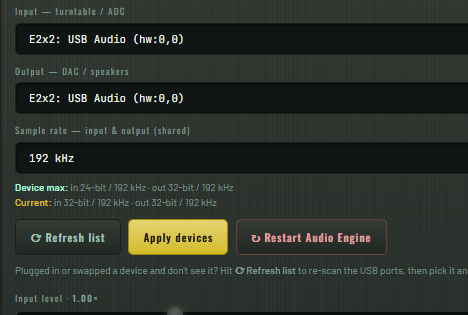
Today’s run was a high-resolution stress test: 32-bit, 192kHz playback through the engine — the most data-rich signal we’ve fed the Kraken yet. And the results have been genuinely impressive, for a reason that makes intuitive sense once you see it:

The higher the resolution, the better the engine repairs. Think of it like this: at higher sample rates, the engine gets more snapshots of every millisecond of music — which means when it finds a click, it has far more surrounding detail to study before reconstructing what belongs there. More data in, more precise surgery out. A repair that’s good at 44.1kHz becomes seamless at 192kHz, because the engine is working with a magnifying glass instead of reading glasses.

The Number That Made Us Smile: 28%

Here’s the stat of the day: running deep clean mode — our most aggressive processing — on a 32/192 stream, CPU usage sat at 28%. One quarter of the processor, doing maximum-effort restoration on more than four times the data of CD-quality audio, in real time, with room to spare.

That 72% of headroom isn’t just bragging rights. It’s what lets the same engine scale down to a Raspberry Pi and still hold real-time performance — and it’s what future features get to live in.

The Techy Bit: Resolution Profiles

Today’s session also feeds directly into a feature currently going into the engine: resolution profiles. We’re building dedicated profiles for the full range of real-world formats — 44.1, 48, 96, 176.4, and 192kHz, at 16, 24, and 32-bit — so the engine tunes its detection and repair behavior to the actual quality of the incoming signal.

Why it matters: a 16/44.1 stream and a 32/192 stream aren’t just different amounts of data — they deserve different handling. Detection thresholds, repair window sizes, and processing strategy all shift with resolution. With profiles, a modest USB dongle gets an engine tuned for what it delivers, and a high-res interface gets an engine that exploits every extra sample it provides. Same promise as always, now sharper: whatever your hardware gives us, the engine makes the most of it.

Meanwhile, “Summer Breeze” has never sounded smoother, the CPU is practically napping, and the only crackle left in this office is coming from the thunderstorm rolling in — which, unlike vinyl noise, we cannot patch. Yet.

So… go drop a needle. The Kraken’s got the rest.
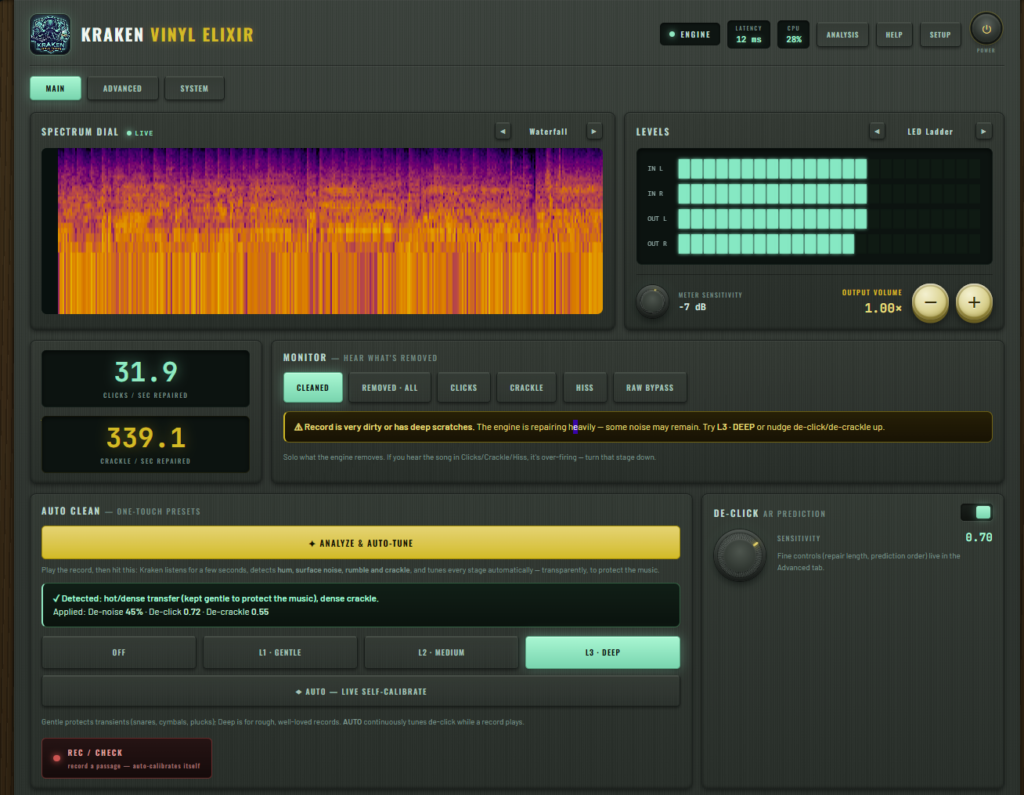
What the Kraken Can and Can’t Do (An Honest Post)

Marketing departments hate posts like this one. Good thing our marketing department is also our engineering department, and the engineer insists.

As the invitational beta gets closer, it’s time to be crystal clear about what Kraken Vinyl Elixir actually does — and just as important, what it doesn’t. Because the fastest way to disappoint someone is to let them expect magic, and the best product relationships start with the truth.

What the Kraken Does — and Does Well

Clicks and pops. This is the heart of the product. Dust ticks, scratch pops, static crackle — detected in real time and repaired by reconstructing the music underneath, not just muting the moment. This is where the engine shines brightest.

Crackle. The patches of fizz and grit from dirty, staticky, or roughly-pressed vinyl — cleaned as the record plays.

Hum. The steady low drone that rides in through cables and electronics. Self-calibration learns your system’s specific electrical fingerprint during setup and filters exactly those frequencies, surgically.

Surface noise. The persistent background hiss and haze of a well-loved record — pulled down so the music breathes, without dulling the top end.

And all of it live. No rendering, no waiting, no workflow. The record plays; the record is cleaner. Flip the Raw/Clean toggle any time and audit the work yourself.

What the Kraken Can’t Do (And Why)

It can’t fix a skip. When a scratch is deep enough that the stylus physically jumps out of the groove, the music from that moment never reaches the software — the stylus never played it. We can’t repair audio that never arrived. A repeating locked groove is the same story: that’s a mechanical problem in the vinyl, not a signal problem in the audio.

It can’t un-warp a record. A warped record makes the stylus ride a hill, which shifts pitch and can stress tracking. That’s geometry, not noise. Flattening warps is a physical job (and a risky one — be careful with the oven-and-glass tricks the internet suggests).

It can’t restore what wear removed. A groove that’s been physically worn smooth by hundreds of plays on a heavy old stylus has lost detail permanently — it was scraped off, not covered up. The Kraken will pull down the noise and make what remains sound its absolute best, and the improvement on worn records is often dramatic. But we’re restoring what’s there, not resurrecting what’s gone. Anyone who promises otherwise is selling something.

It can’t fix distortion your turntable creates. Mistracking from wrong tracking force, misalignment, or a worn-out stylus bakes distortion into the signal itself. The Kraken faithfully cleans the clicks off it — and hands you a clean, distorted signal. (This is exactly why we wrote the turntable setup guide. Five minutes with a force gauge matters.)

It can’t replace cleaning your records. The brush handles what’s on the groove; the Kraken handles what’s in the signal. They’re teammates. A cleaned record plus the Kraken beats either one alone, every time.

The Line We Draw

Here’s the principle underneath all of this: the Kraken repairs damage; it doesn’t invent music. Every repair is built from the real audio surrounding the damage — the actual performance, reconstructed at the wound. When the real audio doesn’t exist (a skip, a worn-away groove), we won’t fake it, and we won’t pretend we can.

That’s a narrower promise than “makes every record perfect.” It’s also a promise we can keep, on the bench, every single day — and one you can verify yourself with a flick of the Raw/Clean toggle.

Your rough records are going to sound dramatically better. Your ruined ones will sound like better-behaved ruined ones. And you’ll always know exactly which is which, because we told you first.

So… go drop a needle. The Kraken’s got the rest — and now you know exactly what “the rest” means.

Anatomy of a Click: Where Vinyl Noise Actually Comes From

We’ve spent a lot of posts explaining how the Kraken removes clicks and pops. Today, the prequel: where does all that noise come from in the first place? Because “the record is old” isn’t really an answer — plenty of old records play beautifully, and plenty of new ones crackle out of the shrink wrap. The real answer is that vinyl noise is a family of different problems, each with its own cause, its own sound, and its own fix.

Meet the family.

Dust: The Everyday Offender

A record groove is tiny — the stylus tip riding it is tracing details finer than a human hair. At that scale, an ordinary speck of dust is a boulder in the road. The stylus hits it, jolts, and your speakers reproduce that jolt as a tick or a soft pop.

Dust clicks are the most common noise on vinyl and the most innocent: the record itself is fine, there’s just debris in the road. A carbon fiber brush before each play clears most of it. What the brush misses, the Kraken catches — a dust click is a textbook “foreign object” for the detection engine, and repairing it leaves zero trace because the groove underneath is undamaged.

Static: The Invisible Troublemaker

Vinyl is plastic, and plastic loves static electricity. Pulling a record out of a sleeve on a dry day can charge it up like a balloon rubbed on a sweater — and then two things happen. First, the charged record becomes a dust magnet, feeding the problem above. Second, the static itself can discharge as tiny crackles the stylus picks up directly.

You’ll know static by the sound of the sleeve: if the record clings and crackles coming out, it’s charged. Anti-static inner sleeves and a humidity-reasonable room help enormously. And the crackle it causes? That’s Kraken food.

Scratches: The Battle Scars

A scratch is actual damage — something dragged across the surface and carved its own path through the groove walls. When the stylus crosses it, you get a loud, sharp pop, once per revolution, arriving with the rhythm of a metronome you didn’t ask for. Deeper scratches hit both channels; light surface scuffs might only tick in one.

Here’s the good news that surprises people: to the detection engine, a scratch-pop is enormous, obvious, and brief — exactly the kind of damage the repair stage was built for. The groove around the scratch still holds real music, so the engine reconstructs the crossing point using the healthy audio on both sides. The scar stays on the record; it just stops arriving at your ears. (A scratch deep enough to make the stylus skip, though, is a different animal — more on that in our “what KVE can and can’t do” post.)

Groove Wear: The Long Goodbye

Every play is a microscopic negotiation between a diamond and soft vinyl. Hundreds of plays — especially on the heavy, worn styli of decades past — gradually shave the fine detail off the groove walls. The result isn’t clicks; it’s a persistent haze: elevated surface noise, dulled highs, a record that sounds tired.

Wear is where honest expectations matter. The Kraken’s denoising pulls the noise floor down and lets the remaining music breathe — often a dramatic improvement — but detail that was physically scraped off the groove fifty years ago isn’t hiding under the noise. It’s gone. We make what survives sound its best.

Pressing Flaws: Born This Way

Sometimes the record came from the factory noisy: recycled vinyl with impurities baked in, a stamper past its prime, a non-fill defect where the vinyl didn’t completely fill the groove mold. This is why a sealed brand-new record can crackle on first play — it was never clean to begin with.

Factory noise behaves mostly like a mix of the categories above — random ticks, patches of crackle — and the Kraken treats it accordingly. It’s also strangely comforting: sometimes it was never your fault.

Why Knowing the Difference Matters

Each family member gets different treatment. Dust wants a brush. Static wants better sleeves. Scratches want the repair engine. Wear wants denoising and realistic expectations. Pressing flaws want a shrug and the Kraken. When you know what you’re hearing, you know what to do about it — and when the beta opens and the analysis view shows you exactly what your record is throwing at the stylus, you’ll be reading that display like a pro.

So… go drop a needle. The Kraken’s got the rest.

Garbage In: Why Your Turntable Setup Decides What the Kraken Hears

There’s an old rule in audio, and in computing, and honestly in cooking: garbage in, garbage out. Kraken Vinyl Elixir can repair clicks, tame crackle, and pull down noise — but it can only work with what your stylus delivers. A well-set-up turntable hands the Kraken clean raw material with some damage to fix. A badly set-up turntable hands it distortion baked into the signal itself, and no software on Earth un-bakes that cake.

So before the beta puts KVE in your hands, let’s make sure your deck is handing it the good stuff. Four things to check, in order of how often they’re wrong.

1. Tracking Force: The Weight of the World (About 2 Grams of It)

Tracking force is how hard your stylus presses into the groove, and both directions of wrong are bad. Too light, and the stylus skips and chatters against the groove walls — mistracking that sounds like harsh distortion on loud passages, and actually damages your records over time as the tip bounces instead of tracing. Too heavy, and you’re grinding the groove down and dulling the sound.

The fix is cheap and satisfying: your cartridge has a recommended range printed right in its manual (for the Ortofon 2M family we run on the bench, it’s around 1.6–2.0 grams), and a small stylus force gauge costs about as much as one used record. Set it once, check it occasionally, done. This is the single highest-value five minutes in vinyl.

2. Anti-Skate: The Invisible Sideways Push

As a record spins, physics quietly drags your tonearm toward the center of the record, which presses the stylus harder against the inner groove wall than the outer one. Anti-skate is the small counterforce that balances this out. When it’s wrong, one stereo channel distorts before the other, and the stylus wears unevenly.

The starting rule of thumb: set anti-skate to match your tracking force number, then trust your ears. If loud vocals get raspy in one channel only, anti-skate is the first suspect.

3. Cartridge Alignment: The Angle of Attack

The stylus was designed to sit in the groove at a specific angle. If the cartridge is mounted crooked or at the wrong position in the headshell, the tip sits skewed in the groove — and you get distortion that gets worse as the record plays toward the center. Inner-groove distortion is partly physics and unavoidable, but bad alignment makes it dramatically worse.

Alignment is set with a protractor — printable ones exist for free, and better ones cost a few dollars. It’s the fussiest job on this list, and you only have to do it when you mount a cartridge. Put on your reading glasses, take your time, and it’s done for years.

4. Level and Stable: The Boring Foundation

The deck should be dead level (a bubble level costs nothing) and sitting on something that doesn’t bounce. A tilted turntable quietly sabotages tracking force and anti-skate — the numbers you carefully set stop being true. And a wobbly surface feeds footstep thumps straight into the stylus, which your speakers then helpfully amplify.

Why This Matters More With the Kraken

Here’s the part that’s specific to us: KVE’s detection engine works by modeling what the music should look like and flagging what doesn’t belong. Clicks and pops don’t belong — they get found and repaired. But mistracking distortion from a badly set up deck isn’t a foreign object sitting on top of the music. It’s woven into the signal the stylus produced. The Kraken faithfully cleans the clicks off a distorted signal, and hands you back… a clean distorted signal.

Five minutes with a force gauge, a rule-of-thumb anti-skate setting, an evening with a protractor once per cartridge, and a bubble level. That’s the whole checklist. Do that, and your stylus hands the Kraken exactly what it was built for: real music, with real damage, ready for real repair.

So… go drop a needle. (A properly weighted one.) The Kraken’s got the rest.