We’ve said it before: “96 kHz” on a box tells you almost nothing, and a restoration engine is only as good as the testing behind it. So today, let’s open the lab door. Here’s exactly how Kraken Vinyl Elixir gets tested — the six pillars of the bench, and what each one catches that the others can’t.
1. Spectrum Analysis — Making Pops Visible
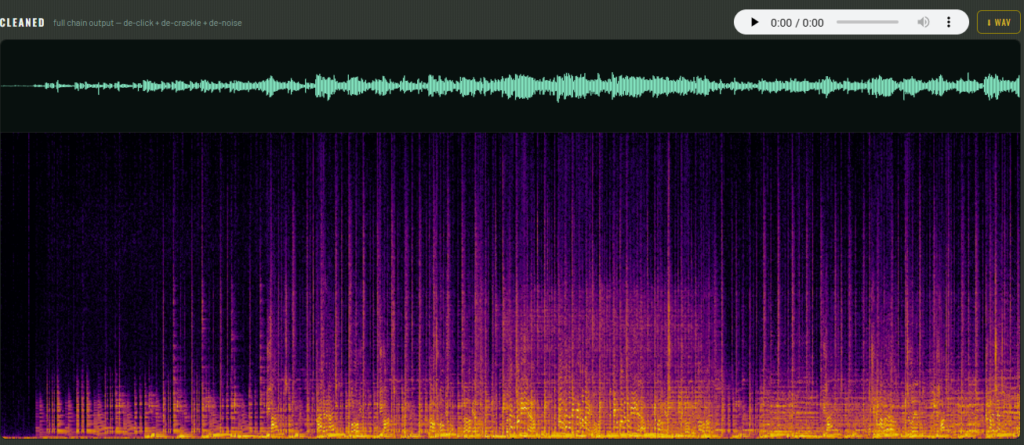
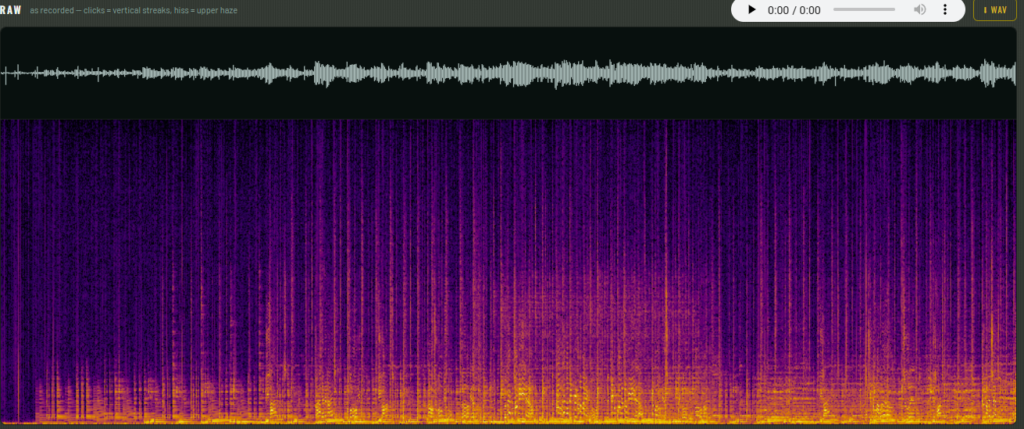
The first tool on the bench is spectrum analysis software, which turns sound into a picture. Time runs along one axis, frequency along the other, and energy shows up as brightness. On that display, a pop isn’t something you hear and try to describe — it’s something you see: a sharp vertical spike slicing across the frequencies, unmistakable against the music around it.
This is how we grade the engine’s homework. Run a noisy record through, look at the display: every click and crackle lights up on the “before” image. Then look at the “after.” If the spike is gone but the music around it is untouched, the engine did its job. If the engine got greedy and shaved off a drum transient that just looked like a click, we see that too — and back to the code we go.
2. The Oscilloscope — Watching the Waveform Up Close
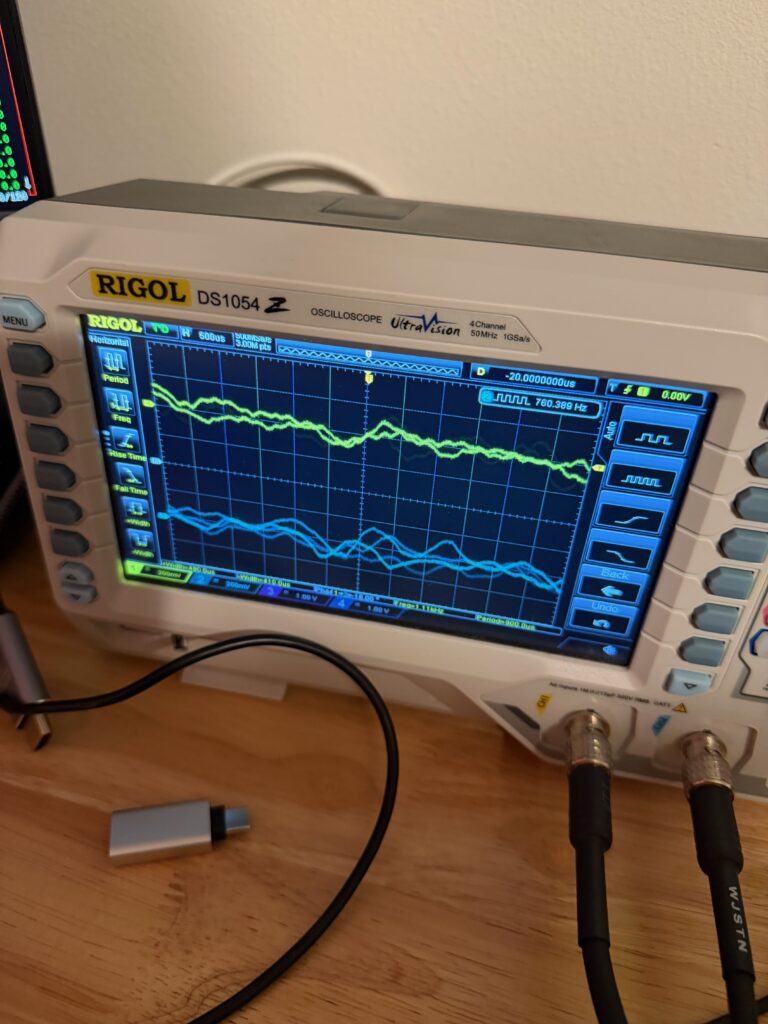
The spectrum analyzer shows the big picture; the oscilloscope shows the crime scene. Our Rigol bench scope lets us zoom into the actual electrical waveform at the moment of a click — microsecond by microsecond — and watch exactly what the damage looks like and exactly what the repair looks like.
This matters because a click repair isn’t just deleting a spike. The engine reconstructs the audio that should have been there. On the scope, a good repair is seamless — the rebuilt waveform flows naturally into the music on either side. A bad repair shows a flat spot, a discontinuity, a little scar. The scope doesn’t let us lie to ourselves.
3. Sound Wave Comparison — Original vs. Processed, Side by Side
The most important question in restoration isn’t “did the noise go away?” It’s “what else changed?” A processor that removes crackle but also dulls the cymbals or softens the attack of a piano note isn’t restoring your record — it’s trading one problem for another.
So we run direct waveform comparisons: the original signal and the processed signal, aligned sample-for-sample, overlaid on top of each other. Anywhere the engine touched the audio, we can see precisely how it was modified. The goal is surgical — big corrections exactly where the damage was, and essentially zero difference everywhere else. When the two waveforms lie on top of each other through the clean passages, we know the music is passing through untouched.
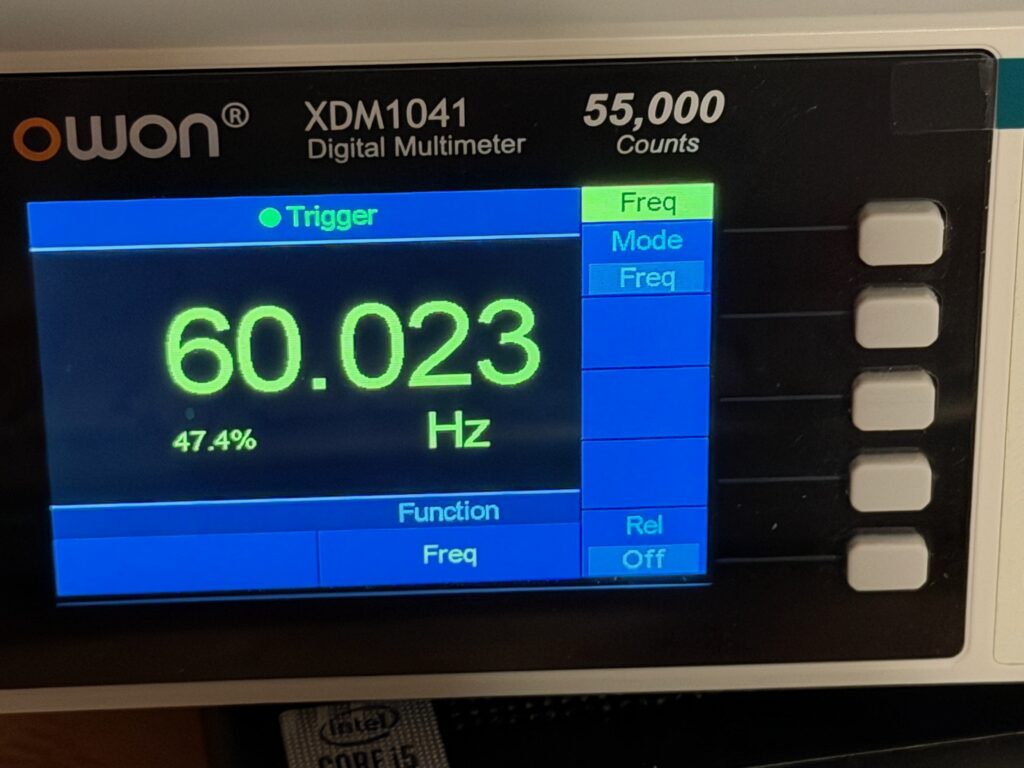
4. The Digital Bench Meter — Hunting the Hum
Not all vinyl noise comes from the vinyl. Some of it rides in on the cables. Electrical noise from your home’s power — transformers, dimmers, ground loops — leaks into the signal through the RCA connections as a low, steady hum.
Our digital bench meter measures the frequency of that hum precisely. That number is a fingerprint: hum at the power-line frequency points to one kind of problem, hum at double that frequency points to another, and each has a different fix. Knowing the exact frequency of what’s coming through real-world RCA connections is what lets us build de-hum processing that locks onto the actual offender instead of blindly carving holes in the bass.
5. Custom Monitoring Software — Watching the Machine Itself
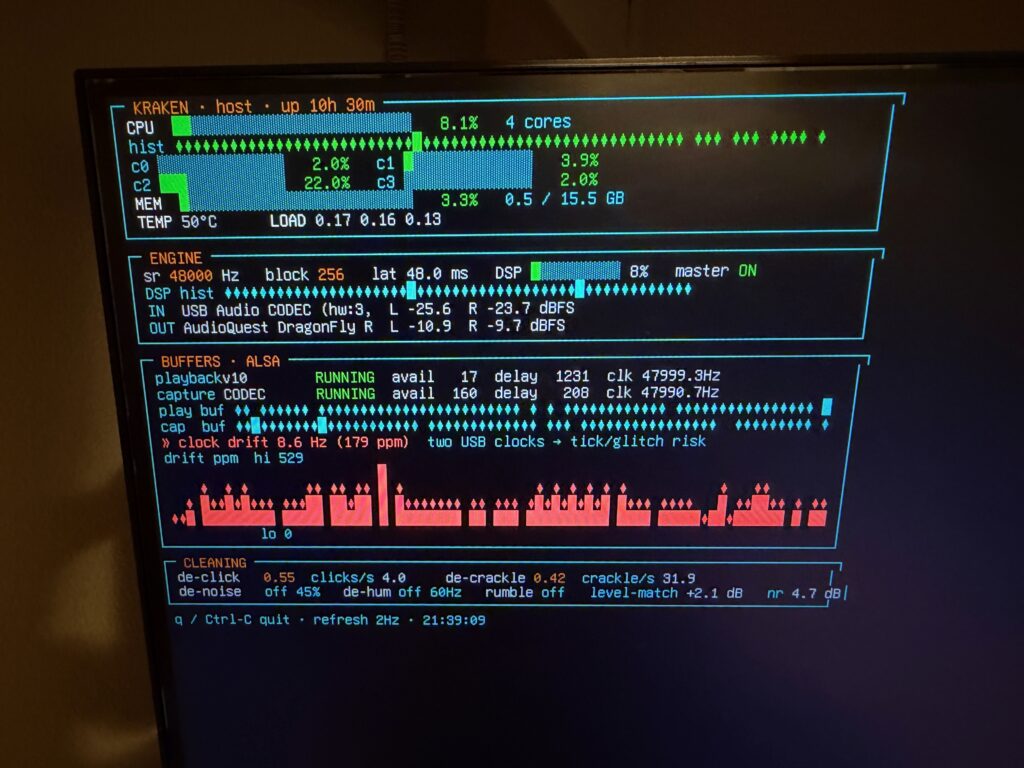
Great audio processing that glitches at minute forty isn’t great audio processing. So we wrote our own suite of monitoring apps that watch the system while KVE runs: USB jitter, buffer levels, system memory, and CPU usage, all logged in real time.
This is where the two-clock problem from our last article gets policed. The monitors show us exactly how the buffers behave as the ADC and DAC clocks drift, how the USB timing holds up hour after hour, and whether the processing load stays comfortably inside what the hardware can deliver. If memory creeps or a buffer trends toward empty over a long session, we see it in the logs long before it would ever become a click in your listening room.
6. Lots of Records!!
And finally, the test equipment that matters most: a big, honest stack of vinyl. Pristine audiophile pressings, thrift-store survivors, records that lived in a garage, records that were loved half to death. Two turntables with matched cartridges spin them for hours, because synthetic test signals can only tell you so much — real grooves throw problems at the engine that no lab signal ever will.
Every algorithm in KVE was tuned on real records and judged the old-fashioned way too: with headphones on and eyes closed. The instruments keep us honest, but the ears make the final call. If it doesn’t pass the listening test, it doesn’t ship — no matter what the graphs say.
Six pillars, one standard: the music comes out better than it went in, every time, for hours at a stretch. That’s the bar, and the bench is how we hold it.
So… go drop a needle. The Kraken’s got the rest.