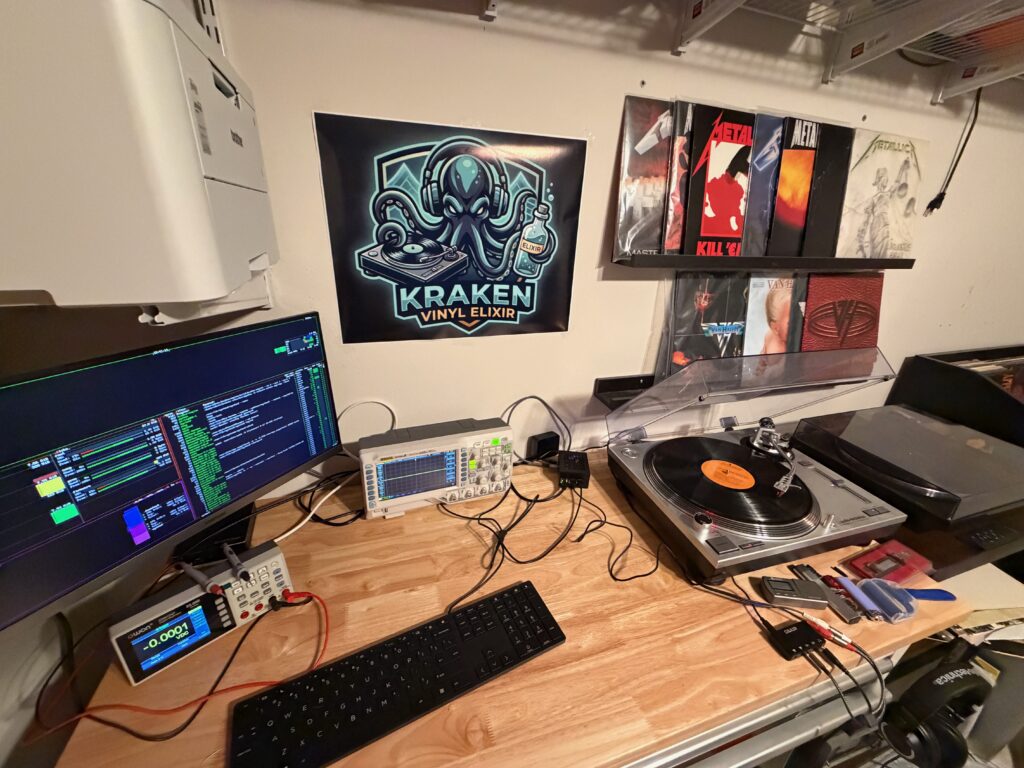
Every product has an origin story. Most of them are polished after the fact to sound inevitable. This one isn’t. Kraken Vinyl Elixir started as a home project that failed, sat on a shelf for the better part of a decade, and came roaring back to life because I threw a record on while I was supposed to be working.
The First Attempt
About eight years ago, I had an idea: what if a little computer could sit between my turntable and my amp and clean up the clicks and pops in real time? The Raspberry Pi was cheap, I had a programming background from years back, and it seemed like a fun weekend project.
The hardware had other plans. The original Raspberry Pi Model B simply couldn’t keep up. The USB subsystem was the first wall — on that board, USB and Ethernet shared a single overworked controller, and trying to stream clean audio through it was a losing battle of dropouts and glitches. Even when the audio made it through, the processor choked on the DSP workload. The sound was disappointing, and no amount of tweaking was going to fix what the silicon couldn’t do. The project went on the shelf. The records kept popping.
2026: “I Wonder If…”
Fast forward to early 2026. I’m working in my office one afternoon and decide to throw a record on. And the crackling drove me crazy. I grabbed my vinyl brush and gave the record a good cleaning — didn’t help. The crackle was in the grooves, not on them, and no brush in the world was going to fix that.
Somewhere between the frustration and the needle sitting back down, the old idea walked back into the room: I wonder if a Raspberry Pi 5 could run that software.
The Pi 5 is a different animal entirely — a genuine multi-core computer that happens to cost less than a decent phono cartridge. So I dusted off the concept and got it running.
And it worked. Technically.
But I wasn’t happy with it. That first revival leaned on ffmpeg filters to do the cleanup, and the quality just wasn’t there. The filters were built for general-purpose audio work, not for the very specific art of finding a click in a groove and repairing the music underneath it. It muffled things it shouldn’t have and missed things it couldn’t afford to. If I wouldn’t listen to it on my own system, I wasn’t going to build it.
Rebuilding It Right
So I tore out the general-purpose filters and rebuilt the audio path from the ground up. The new engine ran on PortAudio for low-latency, real-time throughput, pushing the sound through a custom autoregressive (AR) click detection and interpolation engine — the same family of techniques used in professional restoration software, tuned by ear on my own records. Instead of muting or smoothing over a click, the AR model looks at the audio on both sides of the damage and mathematically reconstructs what the music should have been in that instant.
That early version also picked up a least-squares AR (LSAR) repair stage for stubborn damage, Wiener spectral denoising to pull down surface noise without dulling the highs, and a browser-based interface so I could control everything from my phone instead of dragging a keyboard over to the hi-fi. Along the way I’d experimented with JACK audio routing, second-derivative click detection, and cubic spline interpolation — each one taught me something, and each one got replaced by something better.
Then came the moment that changed this from a tinkering project into a mission. I played a beat-up old record through the new engine for the family. Everybody in the house said wow.
That was the starting point.
Weeks in the Office
What followed was weeks of the best kind of obsession: sampling records, modifying code, listening, adjusting, listening again. New features went in. Interface designs got sketched, built, thrown out, and rebuilt. An EQ section arrived. Two turntables with matched cartridges sat on the test bench next to an oscilloscope, because if you’re going to tune a restoration engine, you’d better be able to measure what it’s actually doing — and then confirm it with your ears anyway.
The software kept getting better, and the pile of records that “deserved another listen” kept getting taller.
The Name
At some point, a project this alive needed a name. It sat between the turntable and the speakers, reached into the signal with a dozen arms at once — detecting, repairing, denoising, archiving — and what came out the other side was something almost magical. A many-armed beast serving up a sonic potion.
Kraken Vinyl Elixir was born.
Eight years from a Pi that couldn’t keep up to a Kraken that won’t quit. The records on my shelf sound better than they have in decades, and now it’s your collection’s turn.
So… go drop a needle. The Kraken’s got the rest.