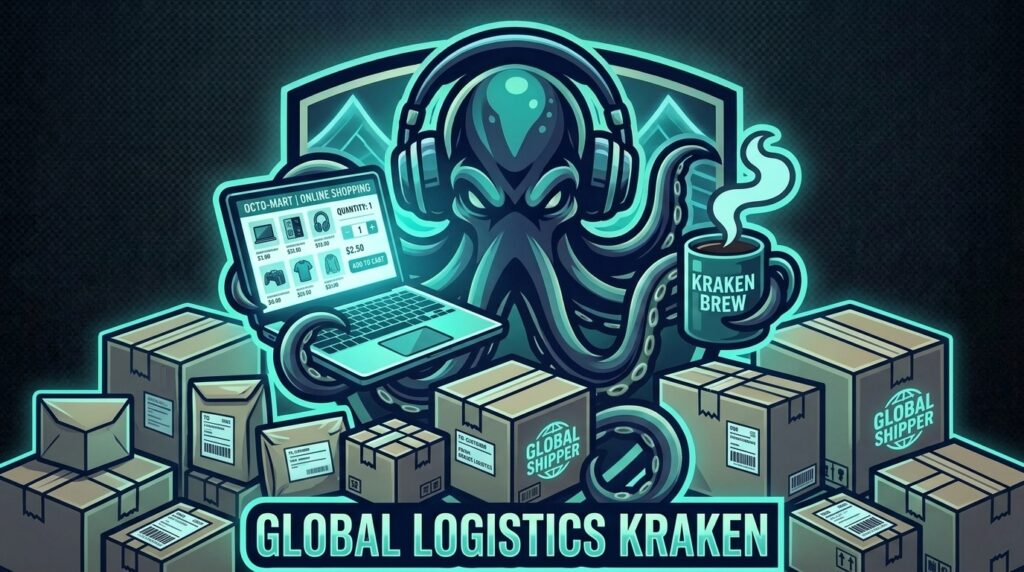
They say the two happiest days in a boat owner’s life are the day he buys the boat and the day he sells it. For those of us in the audio world, it’s simpler: the happiest day is the day the truck comes. And right now, at KVE headquarters, the truck comes almost every day.
Because we’ve entered the most dangerous phase of software development: the testing phase. Also known as the phase where “buying gear” becomes a legitimate, documented, line-item business activity. I have waited my whole life for this.
The Cart Situation
The mission is real, and we’ve told you about it: to test the Kraken properly, we need different DACs, different ADCs, different chipsets, different price points. We need Raspberry Pi 4s. We need more Pi 5s. Every one of these purchases is strategic. Every one has a testing plan.
This is what I tell myself at 11:47 PM as I add a fourth audio interface to the cart.
“It uses a different chipset,” I whisper, clicking Buy Now. “This is science.”
The beautiful thing is: it’s TRUE. That’s the trap. Normally the audio hobbyist brain has to wrestle with justifications like “but it has slightly better specs” or “the reviews said it’s more musical.” Not me. Not now. I have a spreadsheet. I have a methodology. I am not impulse shopping; I am building a compatibility library. The fact that this looks identical to impulse shopping from the outside is a coincidence I refuse to examine.
What’s More Fun Than Shopping? Waiting.
Here’s what nobody tells you: the shopping isn’t even the good part. The good part is the waiting.
There is a very specific ritual, and if you’ve ever ordered audio gear, you know every step:
Morning: check the tracking page. It says “Label Created.” This means nothing has happened, but you check it anyway, twice, in case the label suddenly did something.
Day two: “In Transit — Jacksonville.” Jacksonville! That’s our state. You could theoretically drive there. You calculate whether driving there would be faster. It would not. You consider it anyway.
Delivery day: “Out for Delivery” hits at 7:02 AM, and from that moment, productivity is over. Every diesel engine within a quarter mile triggers a full-body alert. You develop the hearing of a barn owl. That wasn’t the truck. That was a lawn crew. THAT wasn’t the truck either, that was the neighbor’s boat. You begin working from the room with the best window angle on the street, purely by coincidence.
And then — the sound. The unmistakable pneumatic sigh of a delivery truck settling in front of your house. The heavy footsteps. The gentle thump of a box that you absolutely told them to handle with care.
Christmas morning has nothing on “Out for Delivery.”
What Do You Do While You Wait?
Now, a reasonable person might ask: between deliveries, what do you actually do with all that nervous energy? Excellent question. I’ve narrowed it down to three options:
Option A: Improve the utility apps. The monitoring tools, the diagnostics, the analysis software — there’s always another refinement waiting. Nothing burns off truck-watching anxiety like making a jitter monitor 4% more informative.
Option B: Add a little spice to the interface. A polish pass here, a small flourish there. The interface is done, but “done” and “couldn’t be a little cooler” are different things, and I have opinions about knobs.
Option C: Go record shopping. Because the testing stack needs more test material. Obviously. Records good, bad, and tragic don’t find themselves — someone has to rescue that water-damaged crate from the thrift store. For science. (There’s that word again.)
So which did I pick? Come on. You already know.
Everything. The answer is everything. Utility apps got sharper in the morning, the interface got a little extra sauce after lunch, and the record bins got raided before dinner. Turns out “waiting” is just development time with better background music.
The Box Pile
The bench is starting to look like a loading dock. ADCs from different families. DACs of every persuasion. Pi 4s and Pi 5s stacked like little silicon pancakes. Each new arrival gets the same treatment: unboxed, logged, labeled, and sent into the gauntlet — jitter monitoring, clock drift measurement, buffer behavior, the overnight soak test. Some will earn a spot on the recommended hardware list. Some will earn a spot on the other list, the one where the compensation code goes to learn new defensive moves.
The cardboard recycling situation has become a topic of household discussion. I’ve explained that every box represents chipset coverage. This explanation has been received with the enthusiasm you’d expect.
The Honest Truth
Underneath the jokes, this is the job right now: buying, unboxing, benching, and documenting as much different hardware as the budget and the mail system allow — so that when the invitational beta opens in late Q3, the Kraken has already met as many of your interfaces as possible. Every truck that stops out front is another compatibility question answered before you ever have to ask it.
So if you drive a brown truck on the Treasure Coast and you’ve been wondering about the guy who’s way too happy to see you: hello. It’s for science. I have a spreadsheet.
So… go drop a needle. The Kraken’s got the rest.