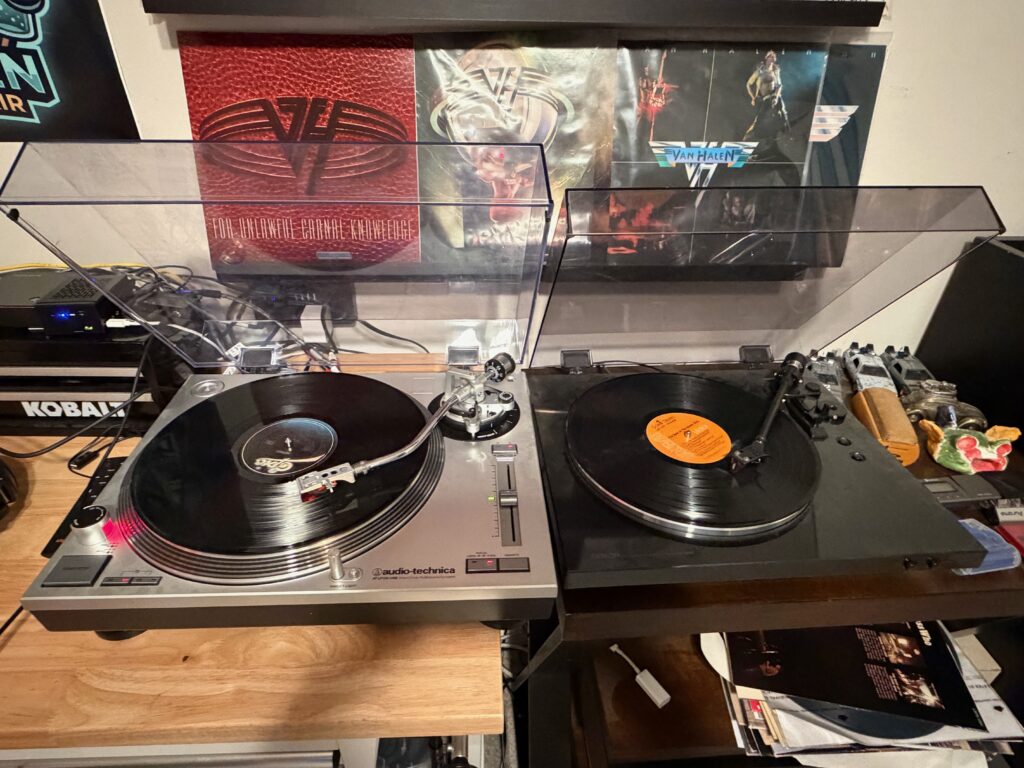
Here’s a debate that has ended friendships: Van Halen or Van Hagar? Same band, same guitarist, same records-selling machine — but put Diamond Dave or Sammy out front and you get two completely different sounds. And here’s the thing that makes the argument immortal: neither answer is wrong. It’s the same band. It’s just a different voice telling the story.
Your turntable has the exact same debate going on, and the lead singer is your stylus.
The Tiny Diamond Doing All the Work
Everything you hear from a record starts at one microscopic point of contact: a shaped diamond tip riding a groove about as wide as a human hair, vibrating thousands of times per second as it traces the walls. The cartridge converts those vibrations into an electrical signal, but the stylus decides what vibrations exist in the first place. Change the stylus, and you’ve changed the voice of your entire system — before the signal ever touches an amp, a speaker, or the Kraken.
Shape Is Everything
The biggest factor is the shape of the diamond, because shape determines how much of the groove wall the stylus actually touches.
Conical (spherical) tips are the simplest — a rounded point, like a ballpoint pen. They ride high in the groove and touch a relatively small, blunt area. Forgiving, durable, but they physically can’t reach the finest wiggles in the groove wall, and the finest wiggles are where the high-frequency detail lives.
Elliptical tips are narrowed front-to-back, so they trace tighter curves. More treble detail, better tracking of complex passages, less distortion as the groove tightens toward the record’s center.
Fine line and other advanced profiles get slimmer and more sculpted still, contacting a taller, thinner stripe of the groove wall. They retrieve detail a conical tip literally never touches — and because they contact more wall area at lower pressure per point, they can also be kinder to your records over the long run.
Here’s a fun side effect: different shapes ride at different depths in the groove. A worn record hammered by decades of conical styli can sound surprisingly fresh under a fine-line tip, because the fine-line is tracing untouched real estate lower on the groove wall. Same record, different singer.
My Band: The Ortofon 2M Family
I’m a big Ortofon 2M fan — Red, Blue, and Bronze — and the family is a perfect demonstration of everything above, because the cartridges are siblings with different voices.
The 2M Red wears an elliptical stylus. It’s the one on both of my bench turntables, and day to day it’s what I reach for. It has a lively, punchy, slightly warm presentation that flatters a huge range of records — the crowd-pleaser that plays the hits.
The 2M Blue swaps in a nude elliptical stylus — the diamond mounted directly instead of on a metal carrier, so there’s less mass wiggling around at the end of the cantilever. Same family sound, but tighter, cleaner, more precise. (Bonus: the Blue stylus fits the Red body, which makes it one of the great upgrade paths in budget hi-fi.)
The 2M Bronze steps up to a fine-line profile, and that’s where the last layer of detail comes out of the groove — air around the cymbals, texture in the vocals, better composure in the inner grooves where lesser tips start to grind.
I like the sound the Reds produce. That’s my ear. Someone else might find the Red too energetic and the Bronze just right, and they’re not wrong — they’re just a Sammy fan. The stylus you love is a preference, not a spec-sheet verdict.
Where the Kraken Fits In
Here’s what your stylus choice means for restoration: the stylus decides what comes out of the groove, and Kraken Vinyl Elixir cleans exactly what your stylus delivers — your cartridge’s voice, minus the clicks, pops, and noise. We don’t impose a “correct” sound on top of your system. If you love the warmth of a Red, you keep the warmth of a Red. If you chase the last shimmer of detail with a fine-line tip, the Kraken protects that detail while it works.
It’s why the bench runs matched cartridges on both test turntables — so when we compare original against processed, the only difference we’re hearing is the processing, never the singer.
Dave or Sammy. Red or Bronze. Pick your voice — the Kraken backs the band either way.
So… go drop a needle. The Kraken’s got the rest.